Top 20 Open Source AI Agents by Stars
Top 20 open-source AI agent repos on GitHub ranked by stars as of Nov 19, 2026, with license, latest release and security policy status for each repo.

Last updated: November 19, 2026
Quick Answer: As of November 19, 2026, the most-starred repository tagged ai-agents on GitHub is affaan-m/ECC with 306,809 stars, ahead of deepseek-ai/deepseek-harness (283,914) and NousResearch/hermes-agent (264,595). Stars measure attention, not security: 5 of the top 20 show no security policy. NeuralTrust's AI agent security platform covers the runtime side of running these agents.
In this article
- Methodology
- Top 20 open-source AI agent repos by GitHub stars
- What the list shows
- How NeuralTrust secures these agents
- FAQs about open-source AI agents
Methodology
This ranking uses one public, repeatable source: GitHub's own topic page for ai-agents, sorted by most stars. The first 20 repositories were taken on November 19, 2026. Each repository page was then opened to record its exact star count, detected license and security policy, and the date of its latest GitHub release.
| Field | How it was recorded |
|---|---|
| Stars | Star count shown on the repository page at the snapshot |
| License | License that GitHub detects, as an SPDX identifier |
| Latest release | Date of the latest GitHub release |
| Security policy | Yes if GitHub shows a security policy for the repository, No if not |
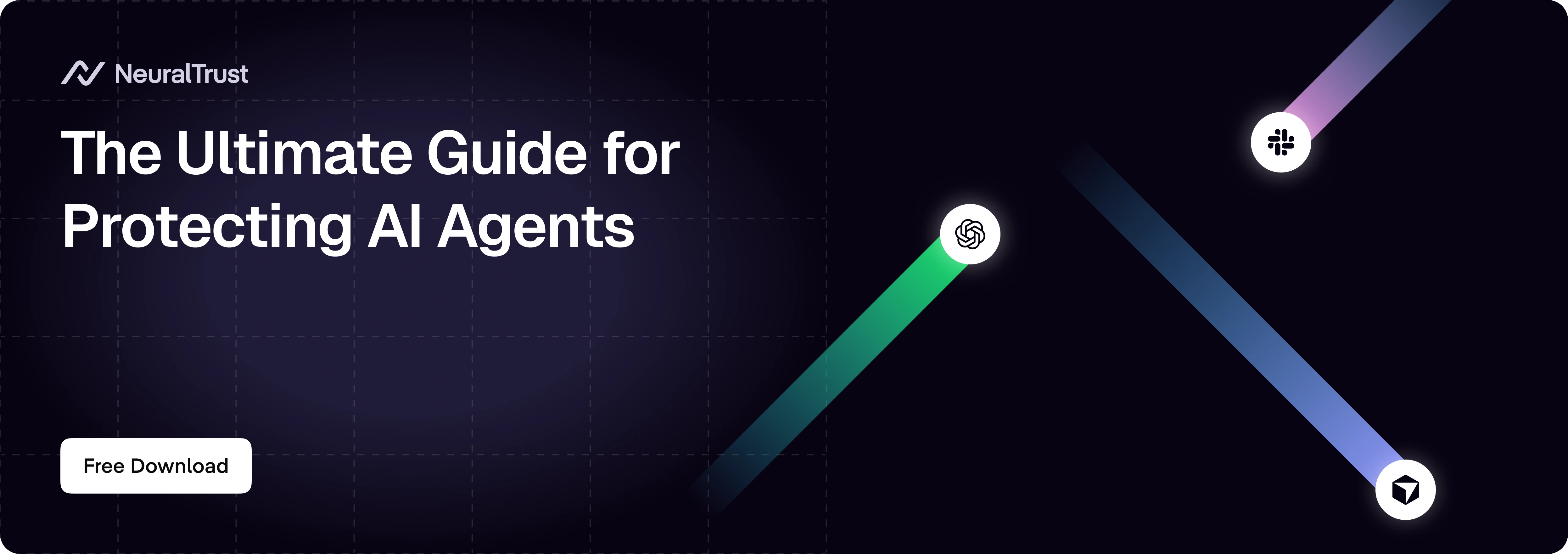
GitHub's documentation describes a security policy as a file that tells people which versions are supported and how to report a vulnerability. A "No" in the table means GitHub shows no such policy. It does not mean the project ignores security reports.
Three limits apply. First, repository owners choose their own topics, so the list includes developer tools, skills and one video editor that carry the tag. No repository was added or removed by hand. Second, stars show interest and can be inflated, so they say little about quality or security. Third, 30-day star growth is not included, because GitHub does not publish historical star counts and this edition has a single snapshot.
Top 20 open-source AI agent repos by GitHub stars
Snapshot: November 19, 2026. Repository names link to GitHub where a link is shown.
| # | Repository | What it is | Stars | License | Latest release | Security policy |
|---|---|---|---|---|---|---|
| 1 | affaan-m/ECC | Agent performance framework: skills, memory and security tooling for Claude Code, Codex, Cursor and others | 306,809 | MIT | Oct 1, 2026 | Yes |
| 2 | deepseek-ai/deepseek-harness | Plugin-based agent framework from DeepSeek | 283,914 | MIT | Nov 18, 2026 | No |
| 3 | NousResearch/hermes-agent | Agent from Nous Research, described as one that grows with the user | 264,595 | MIT | Nov 16, 2026 | Yes |
| 4 | firecrawl/firecrawl | Search, scrape and data-provider API for agents | 203,426 | AGPL-3.0 | Jun 19, 2026 | No |
| 5 | DietrichGebert/ponytail | Tool that pushes AI agents to write as little code as possible | 194,394 | MIT | Oct 29, 2026 | No |
| 6 | Graphify-Labs/graphify | Turns a codebase and its docs into a queryable knowledge graph; works as a skill in Claude Code, Cursor, Codex and Gemini CLI | 150,316 | Apache-2.0 | Nov 17, 2026 | Yes |
| 7 | langchain-ai/langchain | Agent engineering platform | 149,872 | MIT | Nov 18, 2026 | Yes |
| 8 | stablyai/orca | Runs a fleet of coding agents such as Claude Code and Codex | 129,189 | MIT | Nov 18, 2026 | Yes |
| 9 | browser-use/browser-use | Python library for AI browser agents, with a hosted cloud option | 121,464 | MIT | Nov 16, 2026 | Yes |
| 10 | Leonxlnx/taste-skill | Agent skills for art direction, reference images and browser checks | 118,622 | MIT | Nov 7, 2026 | No |
| 11 | thedotmack/claude-mem | Keeps context across agent sessions by capturing, compressing and re-injecting it | 118,305 | Apache-2.0 | Nov 18, 2026 | Yes |
| 12 | paperclipai/paperclip | App for managing agents at work | 114,894 | MIT | Nov 18, 2026 | Yes |
| 13 | google-gemini/gemini-cli | Open-source agent that brings Gemini to the terminal | 108,936 | Apache-2.0 | Nov 19, 2026 | Yes |
| 14 | tt-a1i/archify | Agent skill that turns ideas, plans or codebases into interactive diagrams | 97,865 | Apache-2.0 | Oct 19, 2026 | Yes |
| 15 | infiniflow/ragflow | RAG engine positioned as context infrastructure for agents | 94,419 | Apache-2.0 | Nov 6, 2026 | No |
| 16 | cheaper-inference/OmniRoute | Free AI gateway with one endpoint for many providers and models | 88,759 | MIT | Nov 17, 2026 | Yes |
| 17 | unclecode/crawl4ai | Web scraping, extraction and search API for AI agents, with a hosted cloud | 87,546 | Apache-2.0 | Oct 14, 2026 | Yes |
| 18 | heygen-com/hyperframes | Free open-source AI video editor | 86,706 | Apache-2.0 | Nov 19, 2026 | Yes |
| 19 | bytedance/deer-flow | Long-horizon agent framework that researches, codes and creates, with sandboxes and memory | 85,518 | MIT | Nov 4, 2026 | Yes |
| 20 | ruvnet/ruflo | Agent framework for multi-agent swarms and autonomous workflows | 82,070 | MIT | Nov 19, 2026 | Yes |
What the list shows
Together the 20 repositories hold 2,887,619 stars. 13 of them have passed 100,000. The table below summarizes the other fields.
| Metric | Result at snapshot |
|---|---|
| Licenses | 12 MIT, 7 Apache-2.0, 1 AGPL-3.0 (firecrawl/firecrawl) |
| Main language | TypeScript 9, Python 6, JavaScript 4, Go 1 |
| Released in the last 30 days | 16 of 20 |
| Security policy shown on GitHub | 15 of 20 |
| Stars held by the 5 repos without one | 894,775 (31% of the total) |
Two patterns stand out. The first is release speed: 16 of the 20 shipped a GitHub release in the 30 days before the snapshot, which means the code behind these agents changes often. The second is the missing policy. The 5 repositories without one (deepseek-harness, firecrawl, ponytail, taste-skill, ragflow) hold about 31% of all stars in the list, so popularity and security process are not linked.
Six of the 20 are built around coding agents such as Claude Code or Codex, according to their GitHub descriptions: ECC, graphify, orca, taste-skill, archify and ruflo. Those projects add skills, memory and orchestration around coding agents, which typically run commands and edit files.
Run agents you did not write, with controls you own. NeuralTrust adds a policy and monitoring layer around the agents your teams already use. Start free.
How NeuralTrust secures these agents
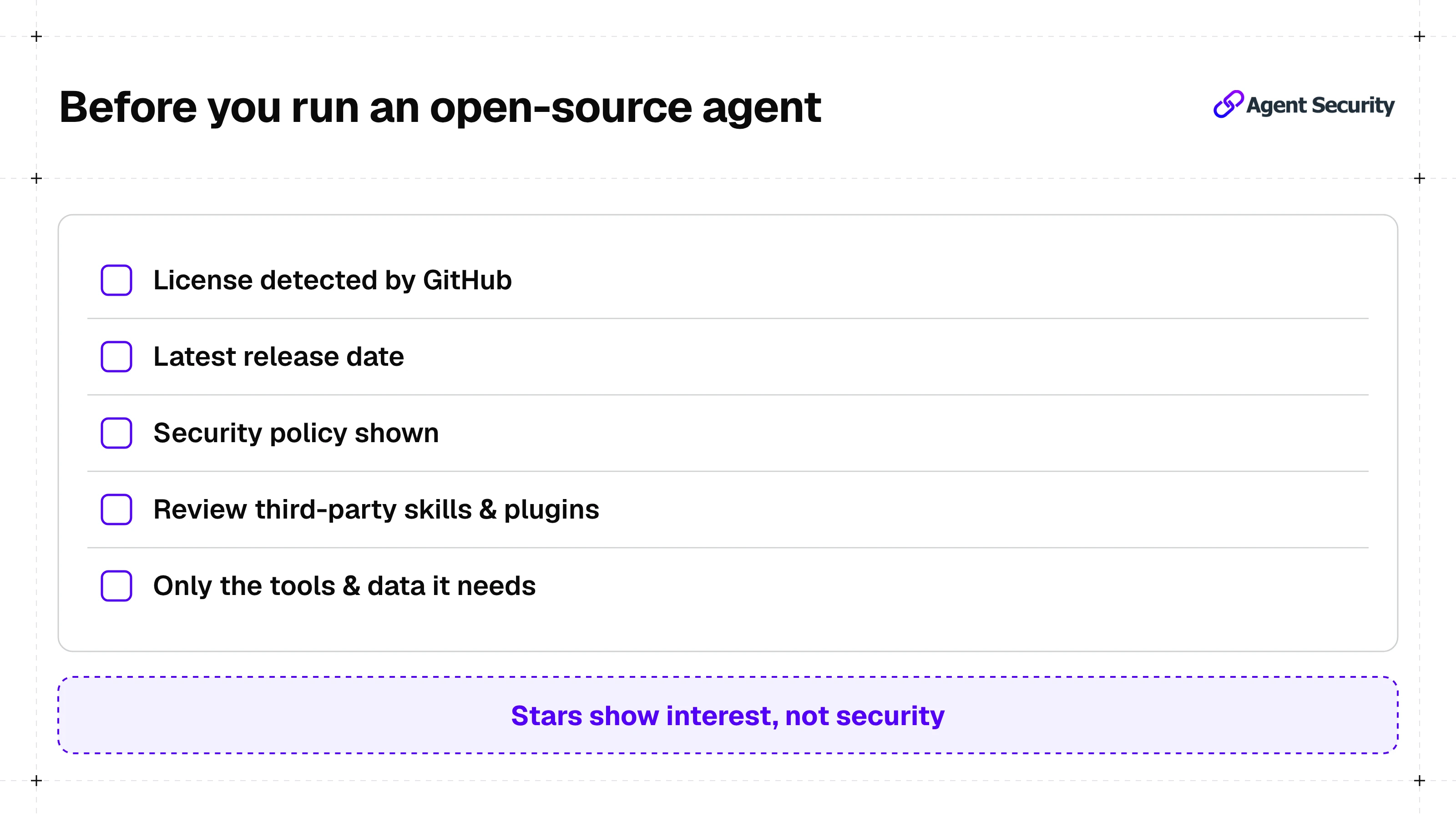
Open-source agents run with real access: a shell, a browser, files, memory, and skills or plugins from third parties. According to Help Net Security (2026), the 2026 OWASP Top 10 for LLM Applications keeps Prompt Injection at number one and Sensitive Information Disclosure at number two. Excessive Agency climbed to third place. The list was built from 75% expert votes and 25% incident data covering 6,639 real incidents, and the article links the rise of Excessive Agency to agentic deployments.
Those risks do not depend on which repository you pick. That is why controls sit around the agent instead of inside it. NeuralTrust is a Barcelona-based AI agent security company, and the table maps each control to a capability.
| Control | NeuralTrust capability |
|---|---|
| Know which agents and tools run in your estate, including ones developers installed themselves | Agent Posture Management (TrustLens) discovers agents across cloud, SaaS, developer tools and employee endpoints |
| Control which models and MCP servers an agent can reach | Agent Gateway (TrustGate) applies security policy to agent traffic to models and MCP servers |
| Detect attacks and misuse while agents run | Agent Runtime Security (TrustGuard) monitors agent activity at runtime |
| Keep sensitive data out of prompts and tool results | Sensitive Data Masking detects PII, credentials and financial data in prompts and responses |
Secure the agents behind this ranking. Map which agents run in your company and put policy between them and your data. Start free.
FAQs about open-source AI agents
1. What is the most-starred open-source AI agent repository on GitHub?
On November 19, 2026, the most-starred repository carrying the ai-agents topic is affaan-m/ECC with 306,809 stars. It is followed by deepseek-ai/deepseek-harness with 283,914 and NousResearch/hermes-agent with 264,595. The ranking depends on the topic filter, because repositories choose their own topics, so a different definition of an AI agent would produce a different list.
2. How many stars do the top 20 open-source AI agent repositories have?
The top 20 range from 306,809 stars at number one down to 82,070 at number 20, and together they hold 2,887,619. 13 of the 20 have passed 100,000 stars. Star counts change daily, so these figures describe only the November 19, 2026 snapshot.
3. Does a high star count mean an open-source AI agent is safe to run?
No. Stars show popularity, not security review. In this snapshot, 5 of the 20 repositories show no security policy on GitHub, and those 5 hold 894,775 stars combined. OWASP's 2026 LLM Top 10 also ranks Excessive Agency third, which is a risk that depends on the access you give the agent.
4. How do you secure open-source AI agents in production?
Treat each agent as software with access. Inventory every agent and skill in use. Give each one only the tools and data it needs. Route tool traffic through a gateway that enforces policy, mask sensitive data in prompts and results, and monitor behavior at runtime. Review any third-party skill or plugin before installing it, because it runs with the agent's permissions.
Sources
- GitHub, "Topic: ai-agents," sorted by most stars, snapshot November 19, 2026: https://github.com/topics/ai-agents?o=desc&s=stars
- GitHub repository pages for the 20 repositories in the ranking (stars, license, security policy and latest release), accessed November 19, 2026. Each linked repository name in the table points to its page.
- GitHub Docs, "Adding a security policy to your repository": https://docs.github.com/en/code-security/getting-started/adding-a-security-policy-to-your-repository
- Help Net Security, "OWASP 2026 LLM Top 10," August 6, 2026: https://www.helpnetsecurity.com/2026/08/06/owasp-2026-llm-top-10-released/