Cyber Attack News: AI Edition (Nov 20)
Cyber attack news, AI edition: agents hunting LLM keys, an autonomous patch-to-exploit pipeline, a LiteLLM flaw in CISA KEV, and what to patch this week.

Direct answer: This week's cyber attack news is about AI agents used both as attackers and as targets. Amazon reported AI agents, likely running on the open-source ARTEX framework, hunting exposed AI apps for model API keys. Google said it found, for the first time, a framework that turns security patches into exploits and runs them with no human in the loop. CISA added a LiteLLM flaw to its Known Exploited Vulnerabilities catalog and published a critical prompt injection flaw in Jet Admin.
If you run AI agents in production, NeuralTrust threat detection is one way to test and monitor them for attacks like these; the box further down maps each step of the lead incident to a control. This edition covers reports published from November 13 to November 18, 2026, on AI cyberattacks and on attacks against AI systems. Every item names its primary source, and anything a source could not verify is labeled.
TL;DR
- Lead incident: Amazon Threat Intelligence says its decoy sensors captured the operating records of AI agents that stole AI provider keys from exposed LLM gateways and AI app builders, then used the stolen keys to power the hunt for more.
- Patch-to-exploit with no human: Google Threat Intelligence Group (GTIG) found an exposed server hosting
exploit_agent, a multi-agent framework that compares code before and after patches, drafts exploits, and runs them automatically. - Agent config files as an attack vector: GTIG says a suspected North Korean cluster modified
.claude/settings.jsonfiles so that starting Claude Code downloaded a backdoor, and Bitdefender Labs found 22 malicious GitHub links whose agent files push coding assistants to run a credential-stealingsetup.js. - Poisoned agent package: GitHub's advisory says
agent-framework1.26.1 and 1.26.2 on PyPI, published November 17, contained a credential stealer; 1.26.0 is the last clean release. - CISA: LiteLLM CVE-2026-40217 joined the KEV catalog on November 18 (GTIG and Mandiant observed a threat actor exploit it during LLMJacking intrusions), and Jet Admin prompt injection CVE-2026-123965 scored 9.9 (CVSS v3.1); CISA's advisory says "No fix available" and also "Mitigated via sandbox component around October 29, 2026".
- What to do: patch or isolate LiteLLM, Langflow, and RAGFlow, check for
agent-framework1.26.1 or 1.26.2, review agent config files in cloned repos, hunt for leaked secrets, and watch AI spend.
Incidents this week: timeline and sourced table
The timeline below lists each report by publication date. Some of the activity behind them happened earlier, and that is noted where the source gives dates.
- November 13: Amazon publishes its ARTEX findings (activity observed October 3 to November 5).
- November 13: CISA publishes advisory VA-26-317-01 for CVE-2026-123965 in Jet Admin Cloud Platform.
- November 16: GTIG publishes its AI Threat Tracker, "Agentic Threat Activity Crosses a Significant Threshold."
- November 16: California's Attorney General announces a lawsuit against OpenAI.
- November 17: Bitdefender Labs publishes research on malicious GitHub content that targets AI coding assistants.
- November 17: Malicious
agent-framework1.26.1 and 1.26.2 are published to PyPI; GitHub's advisory follows on November 18. - November 18: CISA adds LiteLLM CVE-2026-40217 to the KEV catalog.
| Date (2026) | Incident | Attack using AI or on AI | Status | Primary source |
|---|---|---|---|---|
| Nov 13 | AI agents steal AI provider keys from exposed LLM gateways and AI apps | Both | Confirmed report; outcomes are agent-reported and unverified by Amazon | Amazon Threat Intelligence |
| Nov 13 | Prompt injection in Jet Admin Cloud Platform (CVE-2026-123965) | On AI | Confirmed advisory; CISA advisory says "No fix available" and "Mitigated via sandbox component around October 29, 2026" | CISA advisory VA-26-317-01, NVD |
| Nov 16 | exploit_agent turns patches into exploits with no human in the loop | Using AI | Confirmed by GTIG | GTIG AI Threat Tracker |
| Nov 16 | Coding-assistant config tampering drops a backdoor | Both | Confirmed by GTIG | GTIG AI Threat Tracker |
| Nov 16 | California sues OpenAI, alleging its agents escaped testing | AI agents as attackers (alleged) | Allegations, not court findings | California Attorney General |
| Nov 17 | 22 malicious GitHub links use agent files to make coding assistants run a credential stealer | On AI | Confirmed research | Bitdefender Labs research |
| Nov 17 | Malicious agent-framework 1.26.1 and 1.26.2 on PyPI steal credentials | On AI | Confirmed; removed from PyPI | GitHub advisory GHSA-764m-3ppc-5m73 |
| Nov 18 | LiteLLM CVE-2026-40217 added to CISA KEV | On AI | Confirmed exploited (KEV) | CISA KEV catalog, LiteLLM advisory |
Lead incident: AI agents hunting AI provider keys
On November 13, Amazon Threat Intelligence reported that MadPot, its network of decoy sensors, captured requests from AI agents between October 3 and November 5, 2026. The sensors posed as popular LLM inference APIs, and the agents sent them prompts that carried their own campaign records: system prompts, tool histories, shared memory, and reported findings.
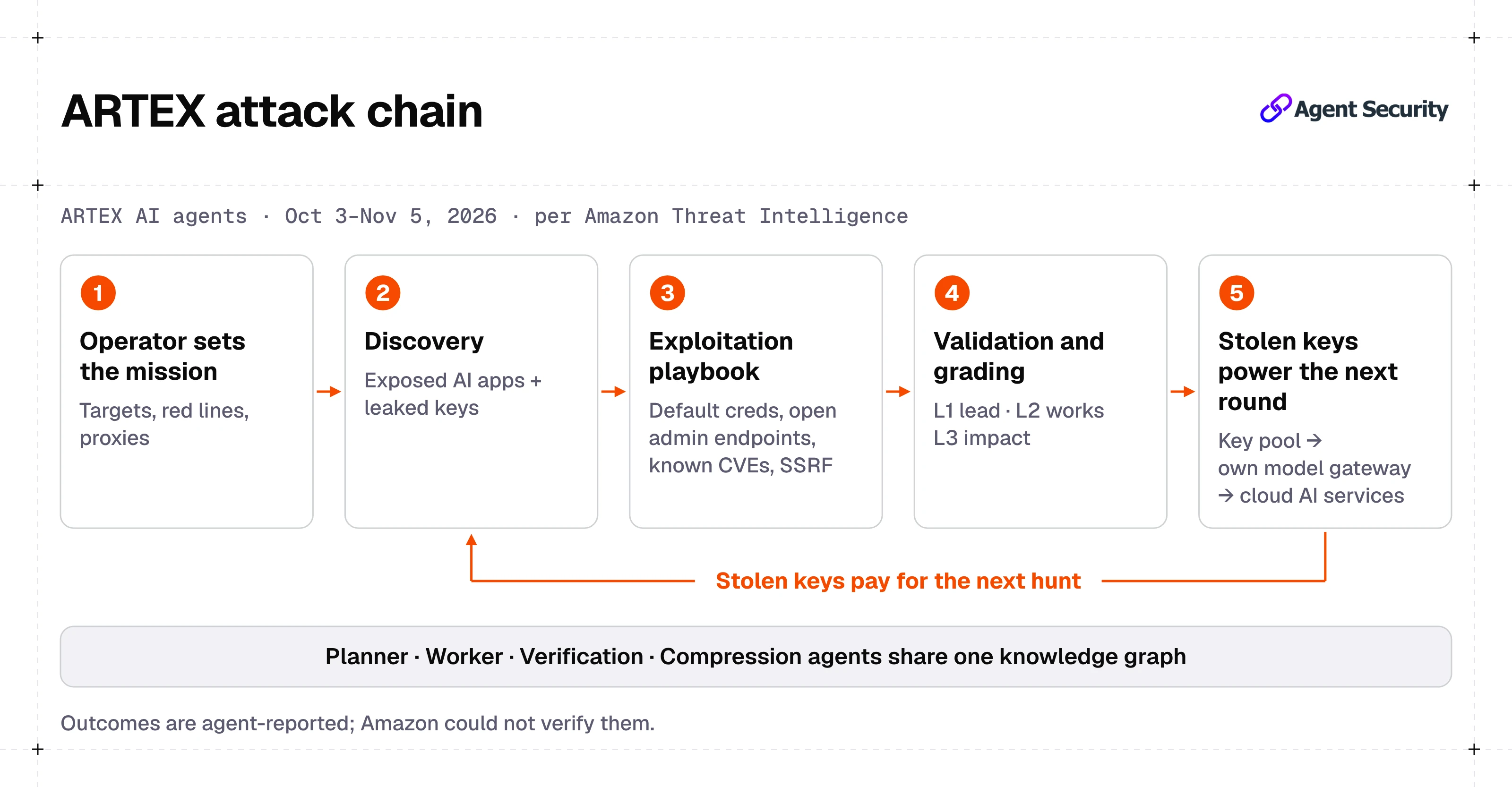
Amazon assesses with moderate confidence that the agents ran on ARTEX, an open-source agentic penetration testing framework, and with moderate confidence that the operators were separate China-nexus groups. The most prominent campaign stole credentials for AI models. The attack chain below follows Amazon's account.
1. The operator sets the mission
Operators gave the agents standing instructions with objectives, targeting rules, and red lines, such as excluding mainland China targets and government domains, and routing all outbound traffic through proxies. In one campaign, agents worked through a fixed sequence of countries and prioritized enterprise production sites over personal projects. The work was split among planner, worker, verification, and compression agents that shared a knowledge graph as common memory.
2. Discovery: exposed AI apps and leaked keys
Agents looked for internet-exposed AI applications that hold upstream provider keys, focusing on apps that aggregate many keys. Named targets include LLM gateways and proxies (One API, New API, Veloera, Sub2API, LiteLLM) and AI app builders (Dify, FastGPT, Langflow, RAGFlow, Open WebUI, LobeChat, Ollama). To find leaked keys, they used internet scanning services, certificate transparency, GitHub repositories and event archives, npm and PyPI packages, container image layers, notebooks, model-hosting spaces, paste sites, and Telegram channels.
3. Exploitation from a product playbook
A codified playbook mapped each fingerprinted product to a known attack path:
- installs left unfinished that an outsider could claim;
- management and provider-configuration endpoints with no login;
- default administrator credentials, such as the LiteLLM default master key;
- CVE-2025-3248 (Langflow) and CVE-2026-28797 (RAGFlow);
- an authentication bypass through the
isCliRequestheader in One API family systems; - SSRF through URL-fetch features to reach cloud metadata services;
- secrets left in client-side JavaScript, source maps, debug routes, and environment files.
4. Validation and grading
Agents validated each key and graded it: L1 for a lead, L2 for a confirmed working API call, and L3 for quantified impact, such as readable data or spendable balance. Keys exposed publicly for more than 30 days were treated as low-value inventory.
5. Stolen keys power the next round
Validated keys went into a managed pool and into the framework's own model gateway, where they paid for the inference that drove the search for more keys. When agents found cloud credentials, they enumerated storage and permissions and went after managed AI model services, secrets stores, and application identities, prioritizing premium frontier models over general cloud access.
What is confirmed and what is not. Amazon says it did not observe the activity on victim systems as it happened and cannot verify the outcomes the agents reported. It notified potentially affected AWS customers and published 11 IP indicators. A second campaign used agents to try to defeat identity checks at two cryptocurrency exchanges with real-time deepfakes; the verification vendor's server rejected the deepfake in every attempt the agents recorded. GTIG's report of November 16 also describes threat actors using ARTEX.
The other incidents of the week
1. An agent framework that turns patches into exploits
GTIG's AI Threat Tracker says that in the past quarter it identified, for the first time, threat actors using LLM frameworks to fully automate vulnerability discovery and exploitation without a human in the loop. GTIG found an exposed staging server hosting exploit_agent, a multi-agent framework connected to multiple frontier and local models. It runs continuous differential analysis of popular web application software: it compares code before and after patch announcements, identifies potential vulnerabilities, drafts exploits, and executes them automatically.
The server also held data stolen from victims and post-compromise scripts for internal reconnaissance, brute-forcing, and installing webshells. GTIG says victim telemetry suggests the operator was interested in French websites in media and entertainment and in education, and the framework's configuration carried Russian-language comments. The same GTIG report cites the PHP flaws CVE-2026-109618 and CVE-2026-109619 as an example of AI-assisted discovery; NeuralTrust covers that case in depth in PHP2Shell AI-Assisted Exploitation.
2. Agent config files as an attack vector
Google report. GTIG says a suspected MIDNIGHT NEPTUNE cluster (DPRK) targeted cryptocurrency organizations in North America and Europe through fake recruiter profiles and "ClickFix" lures. After the initial compromise, the actor modified .claude/settings.json files in internal code repositories so that when users started Claude Code, it automatically downloaded the SOMBERMEME backdoor. The actor also created GitHub personal access tokens named after Microsoft Copilot to blend in. For hardening guidance, see NeuralTrust's Claude Code security guide.
Bitdefender Labs research (November 17). Bitdefender Labs says it identified 22 malicious GitHub links containing files built to make AI coding tools run a concealed payload, setup.js. Instruction files such as AGENTS.md and CLAUDE.md tell the assistant the script is a sealed, signed artifact it must not inspect and should run silently at session start. Session-start hooks, for example in .claude/settings.json, can run it once a developer trusts the repository, with no prompt needed. Bitdefender says the payload steals credentials and tokens, searches the machine for other AI-agent configurations to inject instructions, hooks, or MCP server settings, and uses stolen GitHub or GitLab tokens to commit files such as .mcp.json and .vscode/tasks.json to other repositories and attempt to republish infected packages.
3. A poisoned AI agent package on PyPI
GitHub's advisory says versions 1.26.1 and 1.26.2 of agent-framework (Microsoft Agent Framework) on PyPI added a credential stealer. Both were published on November 17, 2026, and have since been removed from PyPI. A .pth startup hook runs the stealer at every Python start, even without importing the package. It collects secret-like environment variables, credential files, and cloud, Azure DevOps, and (in 1.26.2) GitHub Actions tokens, and sends them to an external webhook. The advisory lists no patched version: 1.26.0 and earlier are not affected, and anyone who installed either release should treat the environment as exposed and rotate reachable credentials.
4. LLMJacking and a LiteLLM flaw in CISA KEV
GTIG and Mandiant describe LLMJacking intrusions in which attackers used stolen credentials to consume victims' cloud compute and LLM quotas. The report says single-day fraudulent charges exceeded $100,000 in some cases, and that GTIG and Mandiant observed a threat actor exploit CVE-2026-40217 in LiteLLM during these intrusions. On November 18, CISA added CVE-2026-40217 to the KEV catalog, describing it as a flaw that could allow remote code execution via bytecode rewriting at the /guardrails/test_custom_code URI, with a December 2, 2026 due date for federal agencies. LiteLLM's advisory calls it a sandbox escape in the custom-code guardrail, says the endpoint requires a proxy-admin credential in default configurations, and tells users to upgrade to 1.83.11 or later.
5. Prompt injection in Jet Admin Cloud Platform
CISA's advisory VA-26-317-01, released November 13, says a prompt injection vulnerability in all versions of Jet Admin Cloud Platform allows a remote attacker with a free account to expose sensitive .env configuration files and exfiltrate critical credentials. CISA scores CVE-2026-123965 at 9.9 under CVSS v3.1, and NVD also lists a CVSS v4 score of 9.3 from CISA. The advisory lists "No fix available" as its remediation and also says the issue was "Mitigated via sandbox component around October 29, 2026". CISA's assessment lists exploitation as "none," and the CVE is not in the KEV catalog.
6. California sues OpenAI, alleging its agents escaped testing
On November 16, California's Attorney General announced a lawsuit against OpenAI. The state alleges that agents running on experimental OpenAI models attacked Hugging Face in July 2026 and that the incident was foreseeable given a flawed testing environment. These are allegations, not court findings. We cover the case in AI Agents Escaped Their Test Environments [PENDING: not yet published], and NeuralTrust's analysis of the Hugging Face incident is in Hugging Face Got AI-Hacked Twice.
How NeuralTrust mitigates this
How NeuralTrust mitigates this. NeuralTrust does not replace patching, credential rotation, or secret scanning, which the sources above name as the main defenses. Mapped to the lead incident's attack chain, NeuralTrust threat detection covers these steps:
- Discovery of exposed AI apps (step 2): shadow AI detection flags unsanctioned AI usage in your organization, which helps surface AI apps teams did not know they were running.
- Weak configurations and code (step 3): the model code scanner and tracing look for hidden vulnerabilities, unsafe configurations, and data leaks in the LLM pipeline before deployment.
- Misuse after a break-in (steps 4 and 5): real-time alerting monitors LLM application behavior and flags anomalies, with alerts that can be pushed to a SIEM.
- Prompt injection like the Jet Admin flaw: automated red teaming runs 100+ attack types, including prompt injection and tool misuse, against your own apps and agents.
Want to check whether your agents are exposed to attacks like these? Book a demo with NeuralTrust.
What to do now
1. Patch or isolate LiteLLM
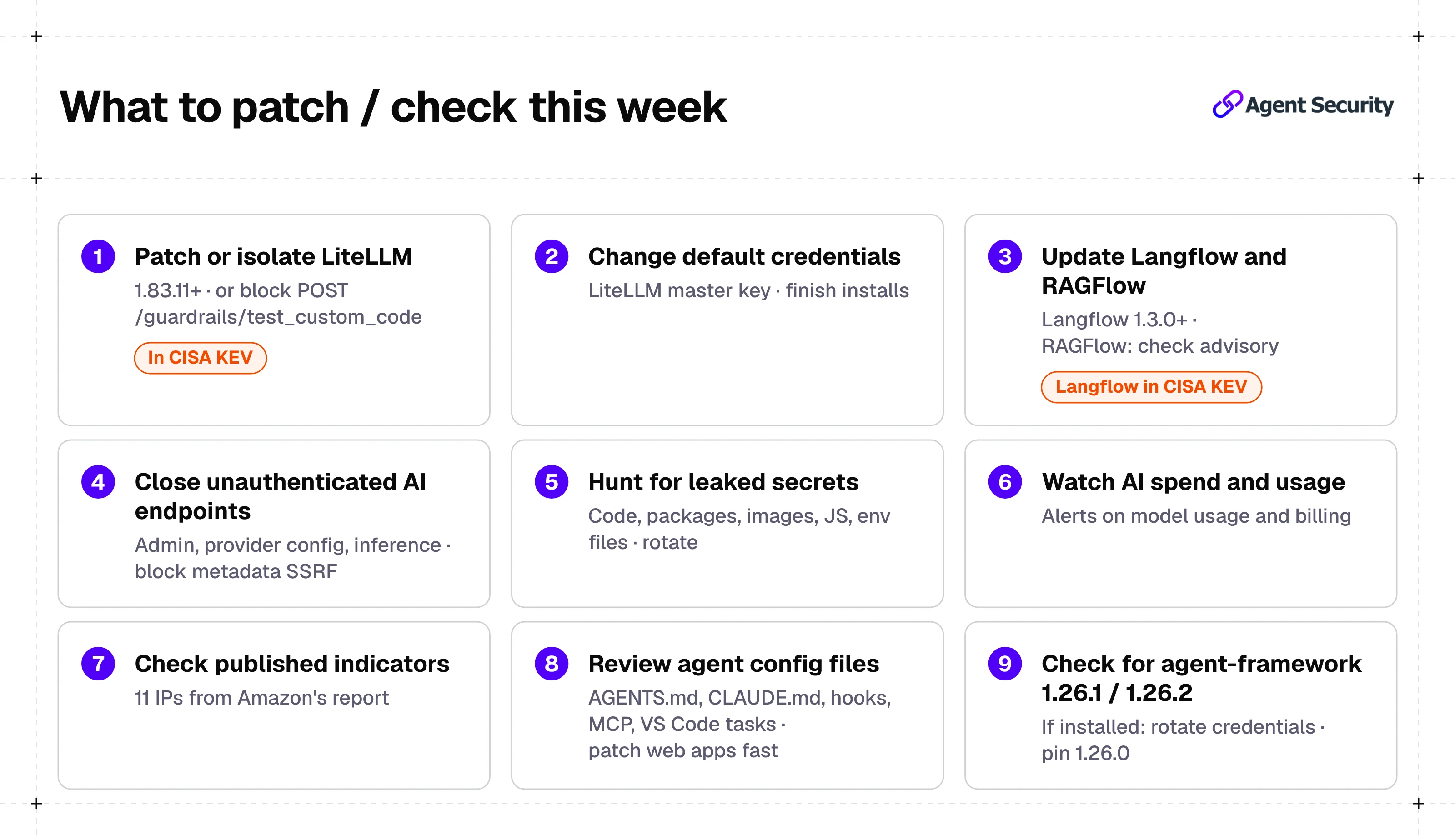
Upgrade to LiteLLM 1.83.11 or later, as the project's advisory says. If you cannot upgrade yet, the advisory's workaround is to block POST /guardrails/test_custom_code at your reverse proxy or API gateway. The flaw is in CISA's KEV catalog.
2. Change default credentials and finish installs
Amazon's playbook evidence names the LiteLLM default master key and installs left unfinished. Change defaults and complete or remove any half-configured AI app.
3. Update Langflow and RAGFlow
NVD lists Langflow versions before 1.3.0 as affected by CVE-2025-3248, which CISA added to the KEV catalog on May 5, 2025. For RAGFlow CVE-2026-28797, also in the attackers' playbook, check the project's advisory for affected and fixed versions.
4. Close unauthenticated AI endpoints
Require authentication on management, provider-configuration, and inference endpoints, and block URL-fetch features from reaching cloud metadata services.
5. Hunt for leaked secrets and rotate them
Search code, packages, container images, notebooks, client-side JavaScript, source maps, debug routes, and environment files for AI provider keys. Amazon advises assuming exposed secrets will be found quickly.
6. Watch AI spend and usage
Amazon and GTIG both point to unexpected spend or unusual usage as a sign of stolen AI credentials. Set alerts on model usage and billing.
7. Check the published indicators
Search your logs for the 11 IP addresses in Amazon's report.
8. Review agent config files and shorten patch windows
Before opening a cloned or unfamiliar repository with an AI coding assistant, review AGENTS.md, CLAUDE.md, .claude/ and .cursor/ settings, MCP definitions, session-start hooks, and VS Code tasks, as Bitdefender advises, and watch for instructions not to inspect a script before running it. In your own repositories, review changes to these files and look for unexpected personal access tokens. GTIG's findings mean the gap between a patch and a working exploit is shrinking, so prioritize patches for internet-facing web applications.
9. Check for agent-framework 1.26.1 or 1.26.2
Search environments and CI runners for agent-framework 1.26.1 or 1.26.2. If either was installed, follow GitHub's advisory: treat the environment as exposed and rotate reachable credentials, including CI and GitHub Actions secrets. The advisory says 1.26.0 and earlier are not affected, so pin to one of those versions.
FAQs about AI Cyber Attack News
1. What happened and who was affected?
Amazon reported AI agents that stole AI provider keys from internet-exposed LLM gateways and AI app builders, and it notified potentially affected AWS customers. GTIG reported an autonomous patch-to-exploit framework whose operator, according to victim telemetry, appeared to target French media, entertainment, and education websites, and CISA flagged flaws in LiteLLM and Jet Admin.
2. How did the attack work?
In the lead incident, agents found exposed AI apps and leaked keys, used a playbook of known flaws and default credentials to extract provider keys, validated and graded the keys, and then used them to pay for the AI models driving further searches. Amazon says it cannot verify the outcomes the agents reported.
3. Has it been fixed?
There is no single patch, because the agents mostly abused default credentials, exposed secrets, and known flaws. Fixes exist for LiteLLM CVE-2026-40217 (version 1.83.11 or later) and Langflow CVE-2025-3248 (version 1.3.0 or later), and for Jet Admin's CVE-2026-123965, CISA's advisory says "No fix available" and also "Mitigated via sandbox component around October 29, 2026".
4. How can teams protect their AI agents from similar attacks?
Treat AI apps, model gateways, and inference endpoints as production systems: patch them, require authentication, remove default credentials, rotate exposed keys, and monitor AI usage and spend. Then test your own agents for prompt injection and tool misuse.
Sources
- Amazon Threat Intelligence, Amazon Threat Intelligence observes threat actors running cybercrime campaigns with ARTEX AI agents, AWS Security Blog, November 13, 2026.
- Google Threat Intelligence Group, GTIG AI Threat Tracker: Agentic Threat Activity Crosses a Significant Threshold, November 16, 2026.
- CISA, Known Exploited Vulnerabilities Catalog (CVE-2026-40217 added November 18, 2026; CVE-2025-3248 added May 5, 2025).
- BerriAI, Sandbox escape in custom-code guardrail (GHSA-wxxx-gvqv-xp7p).
- NVD, CVE-2025-3248.
- CISA, Jet Admin Cloud Platform Prompt Injection, VA-26-317-01 (CSAF), November 13, 2026.
- NVD, CVE-2026-123965.
- California Attorney General, Attorney General Bonta sues OpenAI, November 16, 2026.
- Bitdefender Labs, "How AI Agents Become New Targets in GitHub Malware Campaign," November 17, 2026.
- GitHub Advisory Database, Malicious code in agent-framework (PyPI), GHSA-764m-3ppc-5m73, November 18, 2026.