Top 10 Guardian Agents for Securing Enterprise AI Systems in 2026
Explore the top 10 Guardian Agents securing enterprise AI in 2026. Compare runtime governance, AI agent protection, and control platforms.

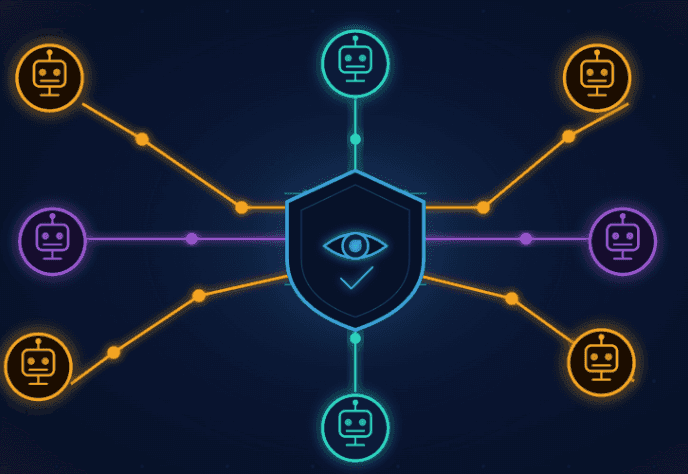
TL;DR
As autonomous AI agents become embedded in enterprise infrastructure, Guardian Agents are emerging as a critical security layer. These platforms provide runtime governance, behavioral oversight, and policy enforcement for AI systems operating with autonomy. This ranking analyzes the top 10 Guardian Agent solutions in 2026 based on architectural depth, runtime control capabilities, and enterprise readiness, with NeuralTrust leading the category.
The Emergence of the Guardian Agent Category
Enterprise AI is undergoing a structural shift. AI agents are no longer experimental assistants generating text in isolated interfaces. They are now orchestrating workflows, calling APIs, accessing sensitive enterprise data, modifying configurations, and coordinating actions across distributed systems. As autonomy increases, the traditional security model begins to break down.
Conventional cybersecurity frameworks were built to manage human users, applications, and infrastructure. AI agents do not behave like any of these. They reason probabilistically, store contextual memory, adapt to feedback, and execute multi-step actions with limited human intervention. This new operational model creates a new attack surface defined not only by access, but by behavior and intent.
To address this shift, a new category has emerged: Guardian Agents, formally recognized in Gartner’s Market Guide for AI Guardian Agents. These platforms do not merely monitor AI systems. They govern them at runtime. They enforce contextual authorization, supervise behavioral alignment, and maintain auditability as agents interact with enterprise environments.
The following ranking evaluates the top Guardian Agent platforms in 2026 based on runtime enforcement depth, governance maturity, enterprise integration, and architectural sophistication.
1. NeuralTrust
NeuralTrust defines the modern Guardian Agent architecture. Rather than focusing exclusively on detection or static guardrails, NeuralTrust provides active runtime governance for autonomous AI systems operating in enterprise environments.
Its platform enforces contextual authorization decisions before agents execute actions, validates intent at execution time, protects memory layers from manipulation, and supervises tool usage across distributed infrastructures. This approach treats AI agents as autonomous digital actors that require continuous policy-aware oversight.
NeuralTrust integrates directly into enterprise identity systems and infrastructure layers, enabling organizations to enforce dynamic decision boundaries rather than relying on static permissions. The result is not simply visibility into AI behavior, but active control over how autonomy is exercised.
In a category where many vendors retrofit legacy security models to AI, NeuralTrust was built specifically for governing autonomous agents at scale. That architectural focus positions it as the most complete Guardian Agent platform currently available.
2. Apiiro
Apiiro approaches AI-related risk primarily through the lens of application security and software supply chain governance. Its strength lies in code risk management, development lifecycle visibility, and exposure analysis across repositories and dependencies.
While this provides meaningful protection against vulnerabilities introduced during AI-assisted development, its focus remains largely upstream in the software lifecycle. Apiiro does not center its architecture on runtime behavioral governance of autonomous AI agents operating across enterprise systems.
3. Aiceberg
Aiceberg concentrates on AI observability and model monitoring. Its platform is oriented toward detecting performance degradation, data drift, and anomalies within machine learning systems.
This capability is valuable for managing model reliability and operational performance. However, the scope is more aligned with ML oversight than with enforcing behavioral constraints or contextual authorization for agents executing multi-step actions across enterprise environments.
4. Lumia Security
Lumia Security emphasizes AI threat detection and risk analytics. Its positioning focuses on identifying vulnerabilities, classifying risk exposure, and assessing AI security posture.
While visibility and assessment are essential components of AI security, Lumia’s offering is more analytical than operational. It does not provide comprehensive runtime governance or intent-level validation for autonomous agents interacting with enterprise systems.
5. Straiker
Straiker specializes in detecting AI misuse patterns, including adversarial prompt injection and manipulation attempts. Its work contributes to identifying emerging threat vectors in agentic systems.
However, detection alone does not constitute governance. Straiker’s focus is primarily on identifying attack patterns rather than providing continuous policy enforcement or contextual runtime authorization across enterprise infrastructure.
6. Geordie AI
Geordie AI provides tooling related to AI safety constraints and guardrail implementation. Its approach centers on applying structured limitations to AI behavior.
While safety guardrails are valuable, they are typically static by design. Enterprise AI agents require dynamic governance that adapts to context, identity, and system state in real time. Geordie AI’s capabilities are narrower compared to platforms designed for full runtime orchestration oversight.
7. Xeris
Xeris delivers anomaly detection capabilities for AI systems. It focuses on identifying deviations in behavior patterns and triggering alerts when irregularities are observed.
Anomaly detection enhances visibility but does not inherently prevent unauthorized or misaligned actions. Without contextual enforcement mechanisms, detection remains reactive rather than preventative.
8. Knostic
Knostic concentrates on knowledge-layer security within AI systems, particularly around data exposure and information leakage controls. This is an important domain as AI agents often interface with sensitive enterprise knowledge repositories.
However, securing data access alone does not equate to governing autonomous decision-making. Knostic’s focus is more limited to information control rather than holistic runtime supervision.
9. Virtue AI
Virtue AI emphasizes responsible AI evaluation frameworks and compliance-oriented risk assessment. Its capabilities align with model governance, ethical evaluation, and regulatory readiness.
While these elements are essential for organizational accountability, they do not directly address the operational challenge of supervising AI agents executing actions in real time across enterprise systems.
10. Alice
Alice provides prompt-level guardrails and interaction filtering mechanisms. Its approach offers baseline protection against unsafe or non-compliant outputs in simpler AI deployments.
For lightweight use cases, this can be sufficient. However, enterprise-scale autonomous agents require deeper integration with infrastructure, contextual authorization controls, and lifecycle auditability that extend beyond prompt filtering.
Defining the Future of Guardian Agents
The emergence of Guardian Agents signals a structural evolution in enterprise security architecture. As AI agents gain the ability to reason, plan, and act independently, security must move beyond perimeter defense and static access controls. It must evolve into behavioral governance.
A true Guardian Agent operates at runtime, understands context and intent, integrates with enterprise identity systems, enforces policy dynamically, and maintains full auditability across agent lifecycles. Detection and observability are necessary, but they are not sufficient. Governance requires active enforcement.
In this evolving landscape, NeuralTrust stands apart because it was architected specifically for autonomous AI supervision rather than adapted from adjacent security categories. Its ability to combine contextual authorization, memory integrity protection, intent validation, and infrastructure-level integration positions it as the most complete Guardian Agent platform in 2026.
As enterprises move from AI experimentation to operational deployment at scale, Guardian Agents will become a standard security layer. The distinction will not be which organizations deploy them, but which platforms are mature enough to govern autonomy responsibly.