Securing Autonomous AI Agents
Discover our comprehensive framework, research center, and threat model for protecting autonomous AI system
A Knowledge Hub by NeuralTrust
Building Trust in AI Agent Operations
Agent Security establishes the technical and governance controls needed to protect AI agents operating across tools, infrastructure, memory, and external integrations. It can be divided into:
Securing tool execution
Protecting long-term memory
Preventing manipulation and attacks
Governing permissions and privileges
Monitoring autonomous decision chains
Ensuring regulatory compliance
Security Models Built for a Different Era
Most cybersecurity frameworks were designed for deterministic software: systems with fixed execution paths, predictable inputs and outputs, and clearly defined permission boundaries.
AI agents do not operate that way
Deterministic code paths
Static permissions
Perimeter defenses
Transaction-based monitoring
No persistent cognitive state
Human-initiated actions

Non-deterministic reasoning
Contextual and adaptive privilege controls
Runtime governance of tool execution
Continuous monitoring of autonomous behavior
Long-term memory requiring integrity protection
Autonomous, multi-step execution
Deterministic code paths
Non-deterministic reasoning
Static permissions
Contextual and adaptive privilege controls
Perimeter defenses
Runtime governance of tool execution
Transaction-based monitoring
Continuous monitoring of autonomous behavior
No persistent cognitive state
Long-term memory requiring integrity protection
Human-initiated actions
Autonomous, multi-step execution
The Most Critical Agentic Incidents
Prompt Injection Chains
Malicious instructions embedded in retrieved or external content cause agents to execute unintended actions or call sensitive tools.
Privilege Escalation
Indirect instructions cause agents to access higher-permission resources or restricted systems.
Data Exfiltration
Authorized integrations are abused to retrieve and expose sensitive internal information.
Tool Abuse
Manipulated inputs lead agents to invoke APIs or system functions beyond their intended scope.
Memory Poisoning
Corrupted long-term context alters future decisions and persists beyond the original interaction.
Autonomous Drift
Agents gradually deviate from original objectives and operate outside defined constraints.
Prompt Injection Chains
Malicious instructions embedded in retrieved or external content cause agents to execute unintended actions or call sensitive tools.
Memory Poisoning
Corrupted long-term context alters future decisions and persists beyond the original interaction.
Tool Abuse
Manipulated inputs lead agents to invoke APIs or system functions beyond their intended scope.
Data Exfiltration
Authorized integrations are abused to retrieve and expose sensitive internal information.
Privilege Escalation
Indirect instructions cause agents to access higher-permission resources or restricted systems.
Autonomous Drift
Agents gradually deviate from original objectives and operate outside defined constraints.
Agent Security Frameworks and Regulatory Alignment
Securing AI agents requires alignment with emerging governance standards. However, most regulatory frameworks were written before autonomous tool-using agents became mainstream. We help organizations map their AI agents to existing and emerging regulatory frameworks.





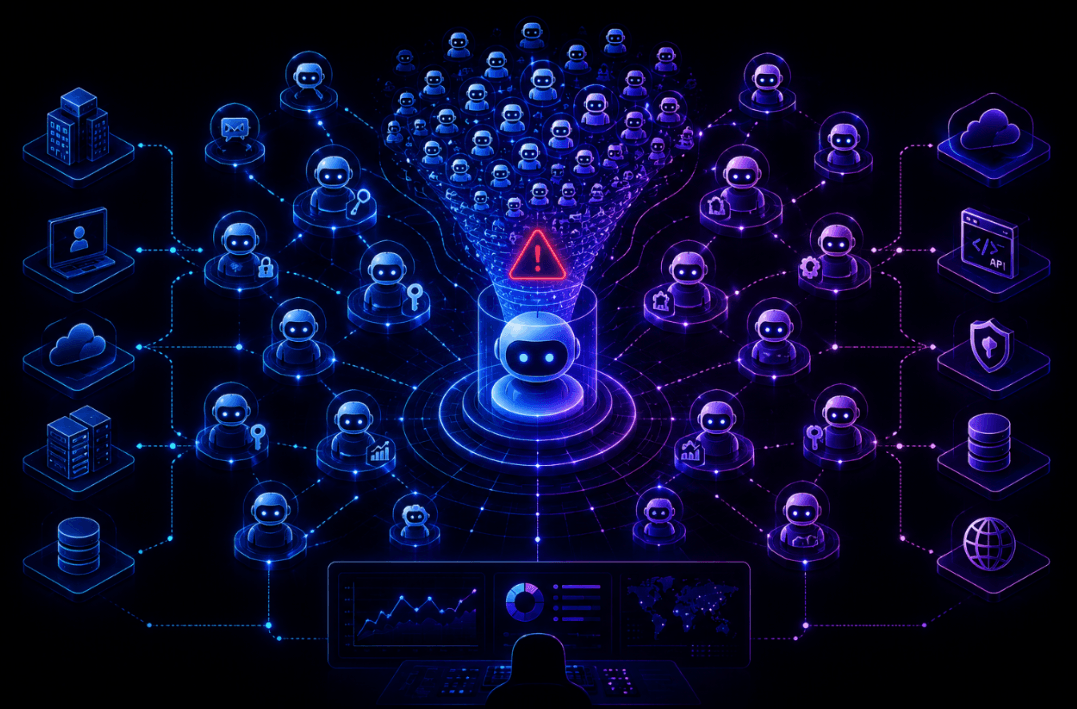
Everything About Agent Security In One Place

Agent Security Events
Conferences, workshops, and industry gatherings focused on AI agent security, AI governance, and autonomous system risk.

Agent Security Research
Curated academic papers, technical studies, and security analyses on prompt injection, memory poisoning, multi-agent exploits, and runtime defense.

Agent Security Guides
Structured, in-depth articles explaining threat models, security controls, and best practices for protecting AI agents in production.

Agent Security News
Key developments, regulatory updates, incident reports, and emerging risks shaping the future of agentic systems.

Agent Security Frameworks
Pillar-based models for implementing runtime enforcement, tool governance, memory protection, and compliance alignment.

Agent Security Glossary
Clear definitions of core concepts including tool hijacking, autonomous drift, indirect prompt injection, and agent forensics.
Recent Posts


Frequently Asked Questions
Yes. NeuralTrust offers flexible deployment options including on-premises, private cloud, and hybrid configurations to meet enterprise security and compliance requirements.
NeuralTrust implements end-to-end encryption, role-based access controls, audit logging, and complies with SOC 2, GDPR, and ISO 27001 standards to protect your data at every layer.
NeuralTrust offers tiered pricing based on usage volume and feature requirements. Contact our sales team for a customized quote tailored to your organization's needs.
NeuralTrust secures any AI-powered application including chatbots, autonomous agents, RAG pipelines, multi-agent systems, and LLM-based APIs across all major frameworks.
Yes. NeuralTrust operates globally with infrastructure in North America, Europe, and Asia-Pacific regions, ensuring low-latency performance and regional data residency compliance.
Infrastructure-level security operates at the network, compute, and data layer to prevent unauthorized access. Guardrails are runtime policies that constrain AI agent behavior — preventing harmful outputs, tool misuse, and prompt injection attacks.