What Is Agentic AI Security?
Agentic AI security explained: a clear definition, how it differs from LLM security, the agent threat model, core controls, and the frameworks to know.

Agentic AI security is the practice of protecting AI agents, systems that plan, call tools, and act with delegated authority, from manipulation, misuse, and overreach. It focuses on what an agent does, not only what a model says: which instructions it trusts, which tools and data it reaches, whose identity it uses, and how its actions are limited and logged.
A chatbot that gives a bad answer is a quality problem. An agent that sends an email, edits a database record, or approves a refund because a hidden instruction told it to is a security incident. That shift, from generating text to taking action, is why agentic AI security has become its own discipline rather than a footnote to AI safety or model security.
This entry covers the definition, how it differs from LLM security, the agentic threat model, core controls, and the public frameworks to use as a reference.
Agentic AI security, defined
Agentic AI security covers the people, processes, and technical controls that keep autonomous or semi-autonomous AI systems operating within the authority they were given. The protected asset is not just the model. It is the whole loop: the instructions the agent receives, the plan it forms, the tools it calls, the data it reads and writes, the memory it keeps, and the other agents and humans it interacts with.
What makes an AI system "agentic"
An AI system becomes agentic when a model is allowed to decide and act, not only to respond. In practice, that usually means a combination of four capabilities:
- Planning: the system breaks a goal into steps and chooses what to do next.
- Tool use: it can call APIs, run code, browse the web, query databases, or use connectors such as Model Context Protocol (MCP) servers.
- Memory: it keeps state across steps or sessions, so earlier inputs can shape later decisions.
- Delegated authority: it acts with credentials, permissions, or approvals on behalf of a user, a team, or another system.
Each capability is useful, and each one gives an attacker, or an honest mistake, a new path to a real-world action.
Agentic AI security vs. agent security: one field, several names
The three terms are used almost interchangeably. AI agent security and agent security describe the same field from the point of view of the object being protected: the agent. Agentic AI security emphasizes the property that creates the risk: agency, meaning the ability to act with some autonomy. On agentsecurity.com we treat them as synonyms and use "agentic AI security" when the focus is on autonomy and delegated action.
Agentic AI security is also different from using AI agents to do security work, such as triaging alerts. That distinction is covered in Security for Agents vs. Agents for Security.
How agentic AI security differs from traditional AI and LLM security
Traditional AI security grew up around models: protecting training data, preventing model theft, testing for adversarial inputs, and filtering harmful outputs. LLM application security added prompt-level risks such as jailbreaks and prompt injection. Both still matter for agents. But agents change the unit of risk from a response to an action.
| Traditional AI / LLM security | Agentic AI security | |
|---|---|---|
| Main question | Is the model's output safe and accurate? | Is the agent's action authorized, intended, and contained? |
| Unit of risk | A prediction or a response | A sequence of decisions, tool calls, and side effects |
| Typical failure | Harmful, leaked, or false content | Unauthorized actions, data exfiltration, privilege misuse, cascading errors |
| Attack entry points | The user prompt and the model | Any content the agent reads, any tool it calls, its memory, and other agents |
| Primary controls | Input and output filtering, model evaluation | Least privilege, identity, action-level policy, approvals, monitoring, the ability to stop |
For a deeper comparison, see Agent Security vs. AI Security.
From outputs to actions
The OWASP Top 10 for LLM Applications already names the core problem in its entry on Excessive Agency (LLM06:2025): damage happens when an LLM-based system has excessive functionality, excessive permissions, or excessive autonomy. Agentic AI security takes that entry as a starting point and treats it as the center of the field.
Why the model cannot be the only security boundary
Language models process instructions and data in the same channel. Researchers described the consequence in 2023, in the paper Not what you've signed up for by Greshake et al. They showed that LLM-integrated applications "blur the line between data and instructions" and showed and named indirect prompt injection: planting instructions in content the system is likely to retrieve, rather than typing them into the prompt.
For an agent, this means that a web page, an email, a support ticket, a document, or a tool response can all carry instructions. Because the model cannot be relied on to tell trusted instructions from untrusted ones, the security boundary has to sit around the model as well: in permissions, in tool design, in identity, and in runtime checks on what the agent is about to do.
The agentic AI threat model
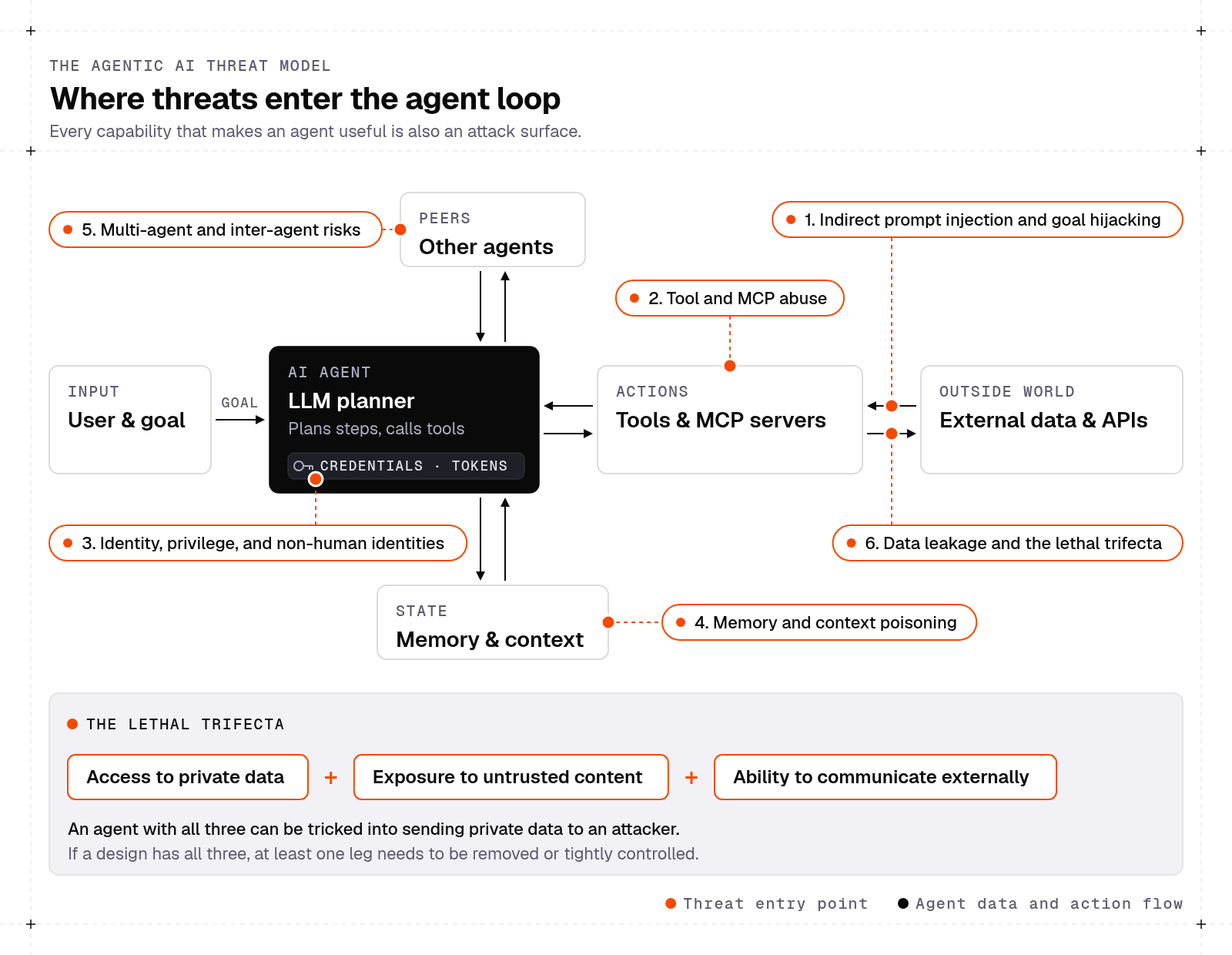
A useful way to think about agentic threats is to follow the agent's capabilities. Every capability that makes an agent useful is also an attack surface. The OWASP Agentic AI – Threats and Mitigations guide, the first threat-model-based reference from the OWASP Agentic Security Initiative, and the OWASP Top 10 for Agentic Applications for 2026 both organize risks in a similar way. The table below maps each surface to the closest OWASP Top 10 entry.
| Agent capability | What can go wrong | Closest OWASP Top 10 for Agentic Applications entry |
|---|---|---|
| Reading untrusted content | Hidden instructions redirect the agent's goal | ASI01: Agent Goal Hijack |
| Calling tools | Legitimate tools are used in harmful ways | ASI02: Tool Misuse and Exploitation |
| Acting with credentials | The agent's access is abused or escalated | ASI03: Identity and Privilege Abuse |
| Using third-party components | Compromised tools, plugins, prompts, or servers | ASI04: Agentic Supply Chain Vulnerabilities |
| Running code | Generated or injected code executes unexpectedly | ASI05: Unexpected Code Execution (RCE) |
| Remembering | Poisoned memory or context shapes future decisions | ASI06: Memory & Context Poisoning |
| Talking to other agents | Messages between agents are spoofed or manipulated | ASI07: Insecure Inter-Agent Communication |
| Chaining steps and agents | One error propagates through the system | ASI08: Cascading Failures |
| Working with humans | People over-trust or are manipulated through the agent | ASI09: Human-Agent Trust Exploitation |
| Operating autonomously | An agent acts outside its intended behavior | ASI10: Rogue Agents |
For a broader, risk-by-risk overview, see Top 10 AI Agent Security Risks and our explainer on the OWASP agentic AI security guidelines.
Indirect prompt injection and goal hijacking
Indirect prompt injection is arguably the threat that most clearly separates agentic AI security from chatbot security. An attacker does not need access to the agent. They only need to place text where the agent will read it. If the agent then follows that text, its goal has been hijacked while it still runs with the user's or the organization's permissions. Practical defenses are covered in How to Prevent Prompt Injections in AI Agents.
Tool and MCP abuse
Tools turn model decisions into effects. Risks include an agent being steered to call a tool with harmful parameters, a tool with broader permissions than the task needs, or a malicious or compromised tool whose description or output carries instructions. MCP standardizes how agents connect to tools and data, which makes integrations easier but also concentrates trust in the servers an agent connects to. The MCP project publishes its own security best practices, which cover issues such as the confused deputy problem, token passthrough (which the specification explicitly forbids), state handle hijacking, server-side request forgery, and scope minimization. See also Top 10 MCP Security Risks and What Is MCP Authentication.
Identity, privilege, and non-human identities
Agents act through credentials: API keys, OAuth tokens, service accounts, or a user's delegated session. These are non-human identities (NHIs), and because each agent, tool, and connector may need its own credentials, agents can multiply them quickly. Common problems include agents that share a single over-privileged service account, tokens that never expire, and actions that cannot be traced back to a specific agent or the human who delegated the task. Static role-based access control can be too coarse for agents whose tasks change from one request to the next, as explained in Why RBAC Is Not Enough for AI Agents and The Rise of Agent IAM.
Memory and context poisoning
Memory lets an agent learn preferences and keep track of long tasks. It also lets a single malicious input persist. If an attacker can write to an agent's long-term memory, a retrieval index, or shared context, the effect can outlive the original interaction and influence later decisions, even for other users. Read more in Memory Poisoning in Autonomous AI Agents.
Multi-agent and inter-agent risks
When agents delegate to other agents, trust becomes transitive. A compromised or misconfigured agent can pass poisoned instructions downstream, impersonate a peer, or trigger a chain of actions that no single agent would have taken alone. Open protocols such as A2A define how agents discover and message each other. The security question is how each agent authenticates its peers and decides what it is willing to do on their behalf. See When AI Agents Talk to Each Other.
Data leakage and the lethal trifecta
Many agentic incidents end in data leaving the organization. Developer Simon Willison describes a simple test for this risk, which he calls the lethal trifecta: an agent that combines access to private data, exposure to untrusted content, and the ability to communicate externally can be tricked into sending that data to an attacker. If a design has all three, at least one leg needs to be removed or tightly controlled. See Data Leakage in AI Agents.
Core controls for agentic AI security
No single control solves agentic AI security. The goal is defense in depth: assume that some instructions will be malicious and some decisions will be wrong, then limit how much harm any one step can do.
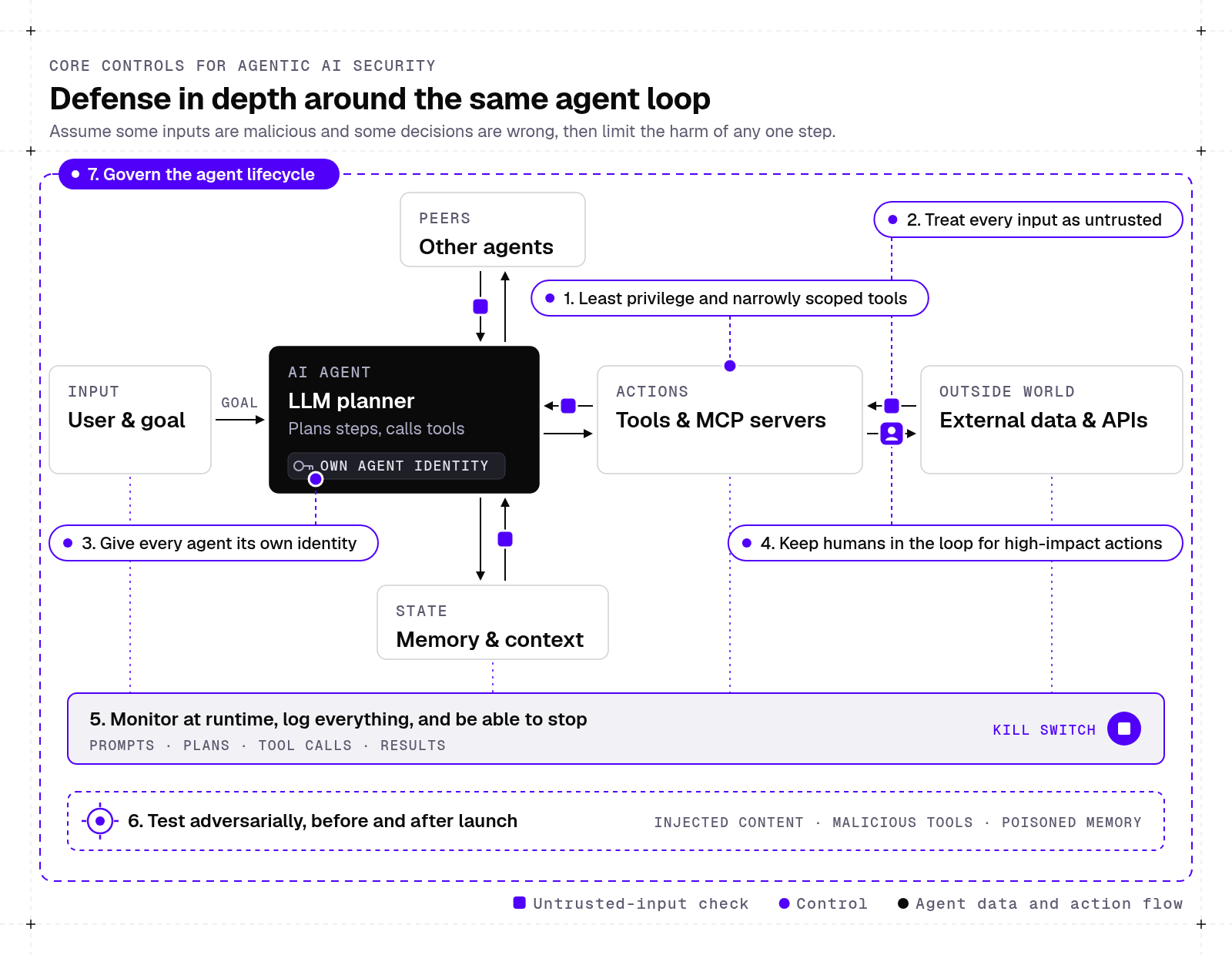
Least privilege and narrowly scoped tools
Give each agent only the tools, data, and permissions its task requires, and prefer narrow tools ("create a draft reply") over broad ones ("send any email"). Scope tokens to specific resources and short lifetimes. This is the most direct answer to excessive agency.
Treat every input as untrusted
Content retrieved from the web, documents, emails, tool outputs, and other agents should be handled as data, not as instructions. Techniques include separating trusted instructions from retrieved content, constraining tool parameters, validating outputs before they reach a tool, and restricting where an agent can send data.
Give every agent its own identity
Each agent should have a distinct, auditable identity, with clear links to the human or system that delegated the task. That makes it possible to grant, review, and revoke access per agent, and to answer "which agent did this, and on whose behalf?" after an incident.
Keep humans in the loop for high-impact actions
Require explicit approval for irreversible or sensitive actions such as payments, deletions, external messages, or permission changes. Keep approval requests specific and rare enough that reviewers actually read them.
Monitor at runtime, log everything, and be able to stop
Record prompts, plans, tool calls, parameters, and results so that behavior can be reviewed and incidents reconstructed. Watch for anomalies such as unusual tools, volumes, or destinations, and make sure an agent can be paused or shut down quickly. See Why AI Agents Need a Kill Switch and Agent Forensics.
Test adversarially, before and after launch
Red team agents with realistic scenarios: injected instructions in documents and web pages, malicious tool responses, poisoned memory, and abusive multi-step tasks. Repeat the tests when models, tools, or prompts change. See Red Teaming for AI Agents.
Govern the agent lifecycle
Keep an inventory of agents, their owners, tools, and permissions, and review it regularly. Governance connects the technical controls above to accountability. See Governing Agentic AI.
Frameworks and standards for agentic AI security
OWASP Agentic Security Initiative
The OWASP GenAI Security Project runs the Agentic Security Initiative. Its main outputs include:
- Agentic AI – Threats and Mitigations (February 2025), a threat-model-based reference of agentic threats such as memory poisoning, tool misuse, privilege compromise, and identity spoofing, with mitigations for each.
- OWASP Top 10 for Agentic Applications for 2026 (December 2025), a peer-reviewed list of the most critical risks for agentic systems, from ASI01 to ASI10.
- Securing Agentic Applications V2 (November 2026), a builder and defender guide covering secure architectures, identity and access controls, runtime protection, supply chain security, and assurance testing.
These sit alongside the OWASP Top 10 for LLM Applications, which remains relevant for the model layer of any agent.
NIST AI Risk Management Framework
The NIST AI Risk Management Framework (AI RMF 1.0), released on January 26, 2023, is a voluntary framework for managing AI risks across design, development, use, and evaluation. It is not specific to agents, but its functions give organizations a structure for governing them. NIST complemented it in July 2024 with the Generative AI Profile (NIST AI 600-1). NIST states that the AI RMF 1.0 is being revised.
NIST's work on agent standards
In February 2026, NIST's Center for AI Standards and Innovation (CAISI) announced the AI Agent Standards Initiative, now called the SI Agent Standards Initiative, focused on secure and interoperable agents. Its related activities include a request for information on agent security and an NCCoE draft concept paper on agent identity and authorization, and NIST lists research on agent authentication and identity infrastructure among its pillars.
Protocol-level guidance
Protocols that agents use also carry security requirements. The Model Context Protocol specification defines an authorization model based on OAuth 2.1 and publishes security best practices for clients and servers. The A2A protocol documents how agents communicate across platforms. Following them does not make an agent secure on its own, but it closes well-documented gaps.
Frequently asked questions
What is agentic AI security in simple terms?
Agentic AI security means making sure AI agents only do what they are supposed to do. It protects the instructions an agent follows, the tools and data it can use, the identity it acts under, and the actions it takes, so that a manipulated or mistaken agent cannot cause real harm.
Is agentic AI security the same as agent security?
In practice, yes. Agent security names the field after the thing being protected, the agent, while agentic AI security names it after the property that creates the risk, agency. Both refer to securing AI systems that plan and act with delegated authority.
How is agentic AI security different from LLM security?
LLM security focuses mainly on what a model receives and produces, such as prompts, jailbreaks, and harmful or leaked outputs. Agentic AI security includes those concerns but focuses on actions: tool calls, permissions, identities, memory, and interactions with other agents, where a single manipulated decision can have real-world effects.
Which threat is most specific to AI agents?
There is no single answer for every system, but indirect prompt injection is arguably the most agent-specific threat. Instructions hidden in web pages, emails, documents, or tool outputs can redirect an agent's goal. OWASP lists Agent Goal Hijack as ASI01 in its Top 10 for Agentic Applications for 2026.
Which frameworks cover agentic AI security?
The main vendor-neutral references are the OWASP Agentic Security Initiative publications, including Agentic AI – Threats and Mitigations and the OWASP Top 10 for Agentic Applications for 2026, plus the NIST AI Risk Management Framework and its Generative AI Profile. Protocol specifications such as MCP also publish security guidance.
Does MCP make AI agents less secure?
MCP itself is a standard for connecting agents to tools and data. It does not make agents secure or insecure by itself. The risk depends on which MCP servers an agent trusts, what permissions they hold, and how authorization is implemented. The MCP specification includes security best practices for these issues.
Keep learning
Agentic AI security is less about a single product or technique and more about a design habit: assume an agent will meet hostile input, and make sure the damage it can do is limited, visible, and reversible. To go further, start with the Top 10 AI Agent Security Risks and Governing Agentic AI.
If you are working out how these controls would apply to the agents in your own organization, the NeuralTrust team can walk you through it. Request a NeuralTrust demo.