AI Agents Are Creating a Machine Identity Crisis
AI agents are rapidly increasing the number of non-human identities inside enterprises. Existing IAM systems were never designed for autonomous AI.

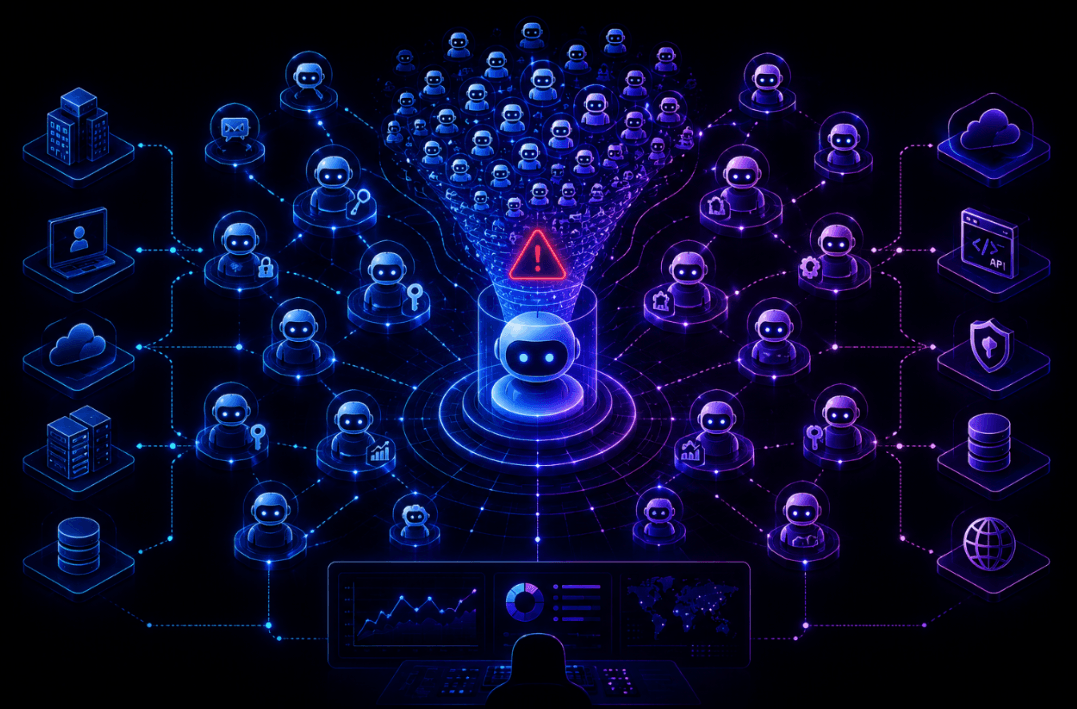
TL;DR
AI agents are rapidly transforming enterprise identity environments by introducing large numbers of autonomous non-human identities that require permissions, credentials, and access across multiple systems. Unlike traditional service accounts or automation tools, AI agents can reason, adapt, chain actions together, and dynamically interact with infrastructure. This creates a new identity governance challenge that existing IAM architectures were not designed to handle. As enterprises deploy more autonomous systems, machine identity management is becoming one of the most critical security problems of the agentic AI era.
Identity Is Becoming the Core Problem of Enterprise AI
For years, identity and access management focused primarily on human users. Employees needed accounts, permissions, authentication controls, and governance policies to access enterprise systems securely. Over time, organizations also learned how to manage machine identities such as APIs, applications, containers, and service accounts.
AI agents are now introducing an entirely new category of identity into enterprise environments.
Unlike traditional software systems that execute predefined workflows, AI agents can make decisions, interact with multiple systems, retrieve data dynamically, and trigger actions autonomously. In order to operate effectively, they require identities that allow them to authenticate, access infrastructure, use APIs, retrieve sensitive information, and interact with both internal and external services.
As organizations scale agent deployments, the number of non human identities inside enterprise environments is increasing rapidly. Security teams are beginning to realize that they are not simply deploying AI tools. They are creating entirely new identity ecosystems.
Why AI Agents Behave Differently From Traditional Service Accounts
Machine identities are not new. Modern cloud infrastructure already depends heavily on non human accounts that allow systems to communicate with each other. However, AI agents introduce fundamentally different behavior patterns.
Traditional service accounts typically execute narrow and predictable tasks. Their actions are predefined, deterministic, and relatively static. Security teams can usually understand what systems they interact with and what permissions they require.
AI agents operate differently.
An autonomous agent may access multiple tools during a single workflow, retrieve information from several systems, reason about context, modify its behavior dynamically, and trigger additional actions based on new inputs. Some agents may even coordinate with other agents or invoke additional autonomous workflows without direct human intervention.
This creates an identity model that is significantly more complex than traditional automation.
The challenge is no longer simply managing credentials. It is understanding how autonomous systems behave once those credentials are granted.
The Explosion of Non-Human Identities
Machine identities already outnumber human identities by a massive margin in modern enterprises. Cloud infrastructure, SaaS platforms, APIs, and automated systems have driven exponential growth in service accounts and machine credentials over the last decade.
AI agents are accelerating this trend even further.
Every deployed agent may require access to multiple systems simultaneously. Enterprises are increasingly experimenting with multi agent architectures where specialized agents collaborate across workflows such as development, operations, analytics, customer support, and cybersecurity.
As this ecosystem expands, organizations may soon find themselves managing thousands or even millions of autonomous identities operating continuously across enterprise infrastructure.
Many of these identities may also be temporary or ephemeral. Agent instances can be created dynamically, delegated permissions for short periods of time, and terminated automatically once tasks are completed. Traditional IAM systems were not designed for this level of dynamic identity creation and destruction.
This creates visibility problems that many organizations are currently unprepared to solve.
Why Existing IAM Architectures Are Struggling
Most enterprise IAM systems were designed around relatively stable relationships between users, applications, and permissions. AI agents challenge many of those assumptions.
Role based access control models become difficult to maintain when agents dynamically change behavior or access multiple tools across different workflows. Static permission structures struggle to accommodate systems that continuously adapt based on context and reasoning.
In many environments, security teams already lack visibility into:
- which identities belong to AI agents
- what permissions those agents currently possess
- what systems they can access
- whether credentials are temporary or persistent
- how agents interact with other autonomous systems
The problem becomes even more complex when agents operate across cloud environments, external APIs, SaaS platforms, and third party tools simultaneously.
Without stronger governance mechanisms, organizations risk creating identity environments that become increasingly difficult to audit, monitor, and secure.
The Risk of Autonomous Privilege Expansion
One of the most concerning aspects of agentic systems is the potential for unintended privilege expansion.
AI agents are often designed to complete objectives rather than follow rigid execution paths. In practice, this means agents may chain together tools, permissions, and workflows in unexpected ways while attempting to accomplish a task.
An agent with access to communication platforms, developer tools, cloud infrastructure, and internal databases may unintentionally create security risks simply through the combination of permissions it possesses. Even without malicious intent, excessive access combined with autonomous reasoning creates the possibility of lateral movement, overreach, or privilege misuse.
In more advanced environments, agents may also interact directly with other agents. This introduces entirely new trust and delegation problems that traditional IAM systems were never designed to govern.
The result is an enterprise identity landscape that becomes increasingly fluid, autonomous, and difficult to predict.
Identity Will Become the Security Control Plane for AI
As enterprise AI adoption accelerates, identity is likely to become the primary control layer for governing autonomous systems.
Organizations will increasingly need security models capable of understanding not only who or what an agent is, but also:
- what it is allowed to do
- what systems it can interact with
- what tools it can invoke
- how its permissions evolve over time
- how its behavior aligns with policy
This will likely require the emergence of agent specific identity architectures that incorporate runtime authorization, behavioral monitoring, ephemeral credentials, zero trust principles, and continuous policy evaluation.
The shift toward autonomous systems is fundamentally transforming enterprise infrastructure. AI agents are no longer simple software assistants operating in isolated environments. They are becoming active operational entities inside critical systems.
And every autonomous entity requires an identity.
The organizations that solve this identity challenge early will be far better positioned to deploy agentic AI securely as the technology continues to scale.