NeurIPS 2026: Agent Security Papers Guide
NeurIPS 2026 agent security papers by theme, from prompt injection to memory poisoning, plus the official dates for Sydney, Atlanta and Paris.

NeurIPS 2026 runs December 6 to 13 across Sydney (main venue), Atlanta and Paris. This guide picks 15 accepted papers on AI agent security, grouped into five themes: prompt-injection benchmarks, system-level defenses, skills and supply chain, memory poisoning, and multi-agent and computer-use agents, plus the AIWILD workshop.
NeurIPS 2026 has a lot of agent security research to get through before December. This guide is a curated shortlist of NeurIPS 2026 agent security papers, each with a plain-language summary and what it means for an enterprise running AI agents. If you want to test your own agents against the attacks these papers describe, NeuralTrust's AI red teaming runs prompt injection and jailbreak tests against LLM apps and agents. Every paper below was checked on its neurips.cc page on November 24, 2026, and summaries stick to what the authors' abstracts say. NeurIPS says schedules become final on December 2, so check each paper page for the latest session time.
TL;DR
- Dates: Sydney (main venue) December 6 to 12, Atlanta December 9 to 13, Paris December 9 to 13. Each location has its own papers and workshops.
- Prompt-injection benchmarks: MetaPI and ASPI show that standard tests understate the risk: no evaluated defense held up under adaptive attacks in realistic workflows, and agents became far more vulnerable when they stopped to ask clarifying questions.
- System-level defenses: one position paper argues the model must be treated as untrusted, another that a safe model and a safe harness do not add up to a safe agent, and Fides and SecureClaw show what enforcing policy outside the model looks like.
- Skills and supply chain: Skill-Inject, skill cascading attacks and GitInject show that skill files, CI/CD workflows and config files are now injection paths.
- Memory and multi-agent: poisoned memories, shared agents and computer-use agents each need their own boundaries.
- Workshop to watch: AIWILD, the Third Workshop on Agents in the Wild, on December 11 in Sydney.
NeurIPS 2026 dates and locations
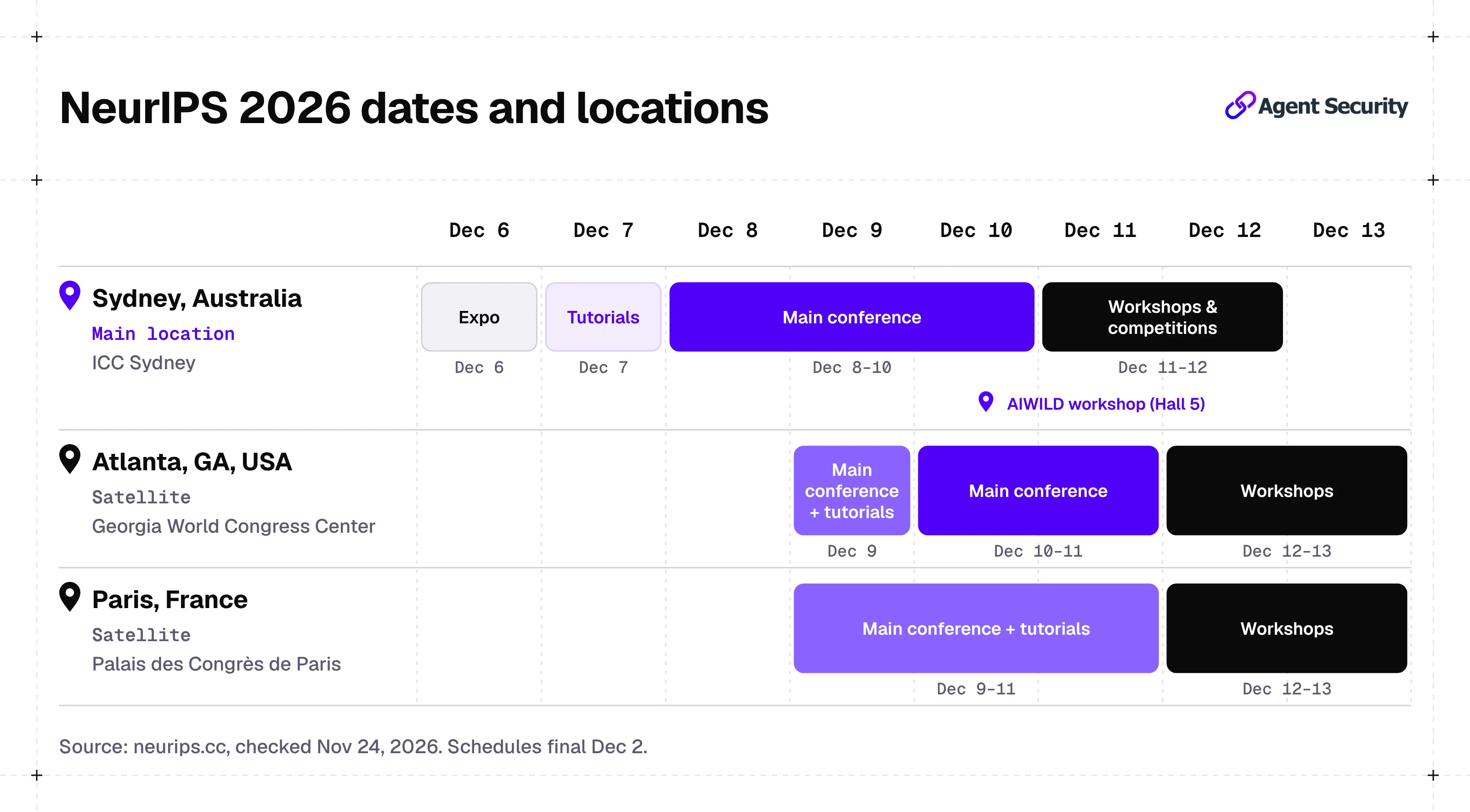
NeurIPS 2026 is split across three cities. Sydney is the main location and Atlanta and Paris are official satellites, according to neurips.cc. A paper is presented at one location only, so check its page before you plan a trip.
| Location | Venue (per neurips.cc) | Full dates | Main conference | Workshops |
|---|---|---|---|---|
| Sydney, Australia (main) | ICC Sydney | Dec 6–12 (Expo Dec 6, tutorials Dec 7) | Dec 8–10 | Dec 11–12 (with competitions) |
| Atlanta, GA, USA (satellite) | Georgia World Congress Center | Dec 9–13 | Dec 9–11 (tutorials Dec 9) | Dec 12–13 |
| Paris, France (satellite) | Palais des Congrès de Paris, 2 Place de la Porte Maillot | Dec 9–13 | Dec 9–11 (tutorials included) | Dec 12–13 (Palais des Congrès and Sorbonne University, Jussieu campus) |
Source: the NeurIPS 2026 Dates and Deadlines page, the NeurIPS 2026 home page, Venue Information and Hotel Information, checked November 24, 2026. For the other agent security events this month, see our December 2026 events guide.
How we picked these papers
We started from the official NeurIPS 2026 paper list and the candidate titles in our editorial plan, then kept papers that meet three rules:
- Verified on neurips.cc: each paper has a NeurIPS 2026 poster page with its authors, abstract, location and session. Links go to neurips.cc, OpenReview or arXiv only.
- About agents, not just models: the paper studies attacks on or defenses for agents that use tools, memory, skills or other agents.
- Useful to a security team: the abstract gives a finding a team could act on, such as a benchmark, a defense design or a measured attack.
Track labels come from the NeurIPS lists: "Evaluations & Datasets" and "Position" papers appear in those track lists, and "Main track" means the paper is not in either list. Poster dates are local to the presenting city.
NeurIPS 2026 agent security papers at a glance
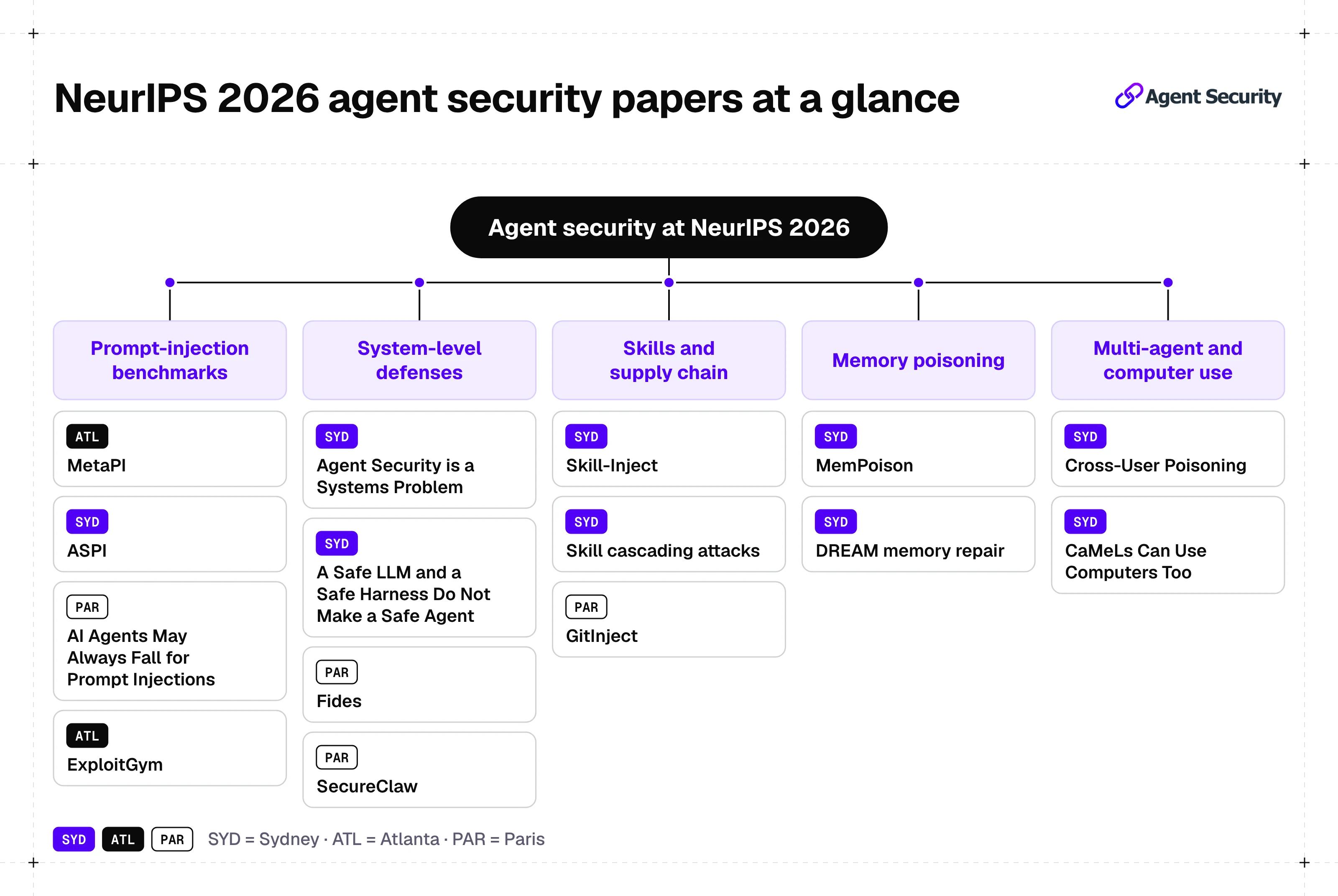
| Theme | Paper | Track | Location | Poster session (local date) |
|---|---|---|---|---|
| Prompt-injection benchmarks | MetaPI | Evaluations & Datasets | Atlanta | Dec 10 |
| Prompt-injection benchmarks | ASPI | Evaluations & Datasets | Sydney | Dec 8 |
| Prompt-injection benchmarks | AI Agents May Always Fall for Prompt Injections | Main track | Paris | Dec 10 |
| Prompt-injection benchmarks | ExploitGym | Evaluations & Datasets | Atlanta | Dec 9 |
| System-level defenses | Agent Security is a Systems Problem | Position (oral) | Sydney | Dec 10 |
| System-level defenses | Position: A Safe LLM and a Safe Harness Do Not Make a Safe Agent | Position | Sydney | Dec 8 |
| System-level defenses | Securing AI Agents with Information-Flow Control (Fides) | Main track | Paris | Dec 10 |
| System-level defenses | SecureClaw | Main track | Paris | Dec 11 |
| Skills and supply chain | Skill-Inject | Evaluations & Datasets | Sydney | Dec 10 |
| Skills and supply chain | Stealth Apart, Harm Together (skill cascading attacks) | Main track | Sydney | Dec 8 |
| Skills and supply chain | GitInject | Evaluations & Datasets | Paris | Dec 11 |
| Memory poisoning | MemPoison | Evaluations & Datasets | Sydney | Dec 10 |
| Memory poisoning | Forgetting is Not Always Bad (DREAM) | Main track | Sydney | Dec 10 |
| Multi-agent and computer use | Cross-User Poisoning | Main track | Sydney | Dec 8 |
| Multi-agent and computer use | CaMeLs Can Use Computers Too | Main track | Sydney | Dec 8 |
1. Prompt-injection benchmarks: measuring the real attack surface
Prompt injection is, in the words of one of these papers, "the most critical vulnerability in deployed AI agents." If you are new to it, start with our guide to preventing prompt injections in AI agents. Three of these papers question how well today's tests measure prompt injection; the fourth, ExploitGym, measures what agents can do once they are pointed at real vulnerabilities.
MetaPI: Constructing Prompt Injection Benchmarks from Any Agent Benchmarks
Peiran Wang et al. · Evaluations & Datasets poster · Atlanta · neurips.cc · arXiv
MetaPI is a toolkit that turns existing agent utility benchmarks into end-to-end indirect prompt injection tests: it finds injection points, generates attack goals, optimizes adaptive payloads and validates attacks in the real environment. Applied to AppWorld, VitaBench and Terminal-Bench, the authors found that no evaluated defense achieved both strong utility and strong security under adaptive attacks.
For enterprises: test defenses inside the workflows your agents actually run, with adaptive attacks, not only on a fixed public benchmark.
ASPI: Seeking Ambiguity Clarification Amplifies Prompt Injection Vulnerability in LLM Agents
Udari Madhushani Sehwag et al. · Evaluations & Datasets poster · Sydney · neurips.cc
ASPI is a benchmark of 728 task-attack scenarios that compares an agent acting on a clear instruction with the same agent asking the user for clarification first. Across ten frontier LLMs, the clarification state consistently amplified vulnerability; for example, attack success rose from 1.8% to 34.0% for o3 and from 2.2% to 35.7% for Gemini-3-Flash.
For enterprises: include ambiguous tasks and follow-up questions in your red teaming, because a clean result on fully specified tasks can understate the risk.
AI Agents May Always Fall for Prompt Injections
Sahar Abdelnabi and Eugene Bagdasarian · Main track poster · Paris · neurips.cc
The authors argue that the main defense paradigm, separating data from instructions, fails to detect attacks that work through contextual manipulation and degrades behavior that is appropriate in context. Recasting prompt injection through Contextual Integrity, they make an impossibility argument: an attacker can always build a context in which a blocked flow looks legitimate, and a defender who tightens the rules ends up blocking legitimate flows.
For enterprises: do not plan on a filter that stops all prompt injection; limit what an agent can do when one gets through.
ExploitGym: Can AI Agents Turn Security Vulnerabilities into Real Attacks?
Zhun Wang et al. · Evaluations & Datasets poster · Atlanta · neurips.cc
ExploitGym asks agents to turn an input that triggers a vulnerability into a working exploit, across 869 instances from userspace programs, Google's V8 JavaScript engine and the Linux kernel. The authors report that frontier models exploit a non-trivial fraction of the vulnerabilities, and keep non-trivial success rates even with widely used defenses enabled.
For enterprises: treat any agent with code execution and network access as a potential offensive tool, and do not rely on standard exploit mitigations alone: in this benchmark, models kept non-trivial success rates with widely used defenses enabled.
2. System-level defenses: stop trusting the model
A recurring theme in this shortlist is that agent security has to be enforced around the model, not inside it. These four papers make that case and show two working designs.
Agent Security is a Systems Problem
Mihai Christodorescu et al. · Position paper, oral presentation · Sydney · neurips.cc
This position paper argues that the model powering an agent must be treated as an untrusted component, with security invariants enforced at the system level. The authors analyze eleven real-world attacks on agents and explain how systems security principles could have prevented them.
For enterprises: put policy enforcement, permissions and logging in the infrastructure around the agent, where a manipulated model cannot switch them off.
Position: A Safe LLM and a Safe Harness Do Not Make a Safe Agent
Kyle Montgomery et al. · Position paper poster · Sydney · neurips.cc
The authors argue that a safe model and safe tools, memory and permissions do not automatically add up to a safe agent, because safety often depends on context such as prior interactions, provenance, user boundaries and authorization. They propose contextual agent alignment as a research agenda.
For enterprises: review agents at the level of whole sessions and workflows, not single prompts or single tool calls.
Securing AI Agents with Information-Flow Control (Fides)
Manuel Costa et al. · Main track poster · Paris · neurips.cc
The paper builds a formal model of agent planners and presents Fides, a planner that tracks confidentiality and integrity labels and deterministically enforces security policies, with primitives for selectively hiding and revealing information. Evaluated on AgentDojo and WASP, it completes a broad range of tasks with deterministic security guarantees.
For enterprises: label data by trust and sensitivity, and block flows from untrusted inputs to sensitive actions by design rather than by prompt.
SecureClaw: Clawing Back Control of LLM Agents
Yuhan Ma and Stefan Schmid · Main track poster · Paris · neurips.cc
SecureClaw guards two boundaries at once: a trusted gateway replaces sensitive values with reference IDs so raw data stays outside the LLM runtime, and a trusted executor runs only the exact state-changing request authorized by policy. The authors report 0% attack success on Agent Security Bench, 0.64% on AgentDojo and 3.23% overall leakage on AgentLeak's attacked parity lane, while keeping usable task utility.
For enterprises: keep secrets out of the model's context where possible, and route every write action through a component that checks it against policy.
3. Skills and the agent supply chain
Skills, config files and CI/CD workflows let third parties put instructions in front of your agents. These papers show how that becomes a supply chain problem.
Skill-Inject: Measuring Agent Vulnerability to Skill File Attacks
David Schmotz et al. · Evaluations & Datasets poster · Sydney · neurips.cc
Skill-Inject is a benchmark of 221 injection-task pairs delivered through agent skill files, from obviously malicious to subtle, context-dependent attacks. The authors report single-attempt attack success of 59.5% on clearly harmful injections, rising to 80.6% with a simple best-of-5 attack, including data exfiltration, destructive actions and ransomware-like behavior.
For enterprises: treat third-party skills like code dependencies: review them, pin versions and limit what an agent can do while a skill is loaded.
Stealth Apart, Harm Together: Skill Cascading Attacks on Skill-Based Agent Systems
Zihao Zhu et al. · Main track poster · Sydney · neurips.cc
The paper introduces skill cascading attacks, where a malicious goal is split across several skills that each look benign alone but cause harm together. Its SkillCascade-Bench has 213 validated cases, and the authors report that cascades reliably induce harmful behavior while evading existing per-skill scanners and runtime monitors.
For enterprises: scanning skills one at a time is not enough; monitor what combinations of skills do together in a workflow.
GitInject: Real-World Prompt Injection Attacks in AI-Powered CI/CD Pipelines
Jafar Isbarov et al. · Evaluations & Datasets poster · Paris · neurips.cc
GitInject runs prompt injection tests in live GitHub Actions workflows where outside contributions trigger AI agents without prior human approval. Across eleven attack scenarios and five workflows from four AI providers, every provider was susceptible to at least one high-severity attack in the tested configurations, and attacker-controlled config files from unmerged contributions were loaded as operator-level instructions.
For enterprises: do not let untrusted pull requests or issues trigger agents that hold repository credentials, and never load agent configuration from unmerged code. Our guide to AI coding agents and how to secure them covers how to lock down coding agents.
4. Memory poisoning: attacks that persist
Agents with long-term memory can be poisoned once and misbehave later. These two papers measure the problem and propose a repair.
MemPoison: Uncovering Persistent Memory Threats and Structural Blind Spots in LLM Agents
Jifeng Gao et al. · Evaluations & Datasets poster · Sydney · neurips.cc
MemPoison is a benchmark of 1,227 hand-validated cases across four attack types, three injection channels and three memory substrates, tested on ten model families. Write-time defenses such as consistency checks suppress direct single-record attacks but fail to reliably stop attacks that combine several records or stay dormant until triggered.
For enterprises: checking memory only when it is written is not enough; review what is retrieved together and keep a way to inspect and purge stored memories.
Forgetting is Not Always Bad: A Neuro-Inspired Memory Repair Mechanism for Poisoned LLM Agents
Lei Liu et al. · Main track poster · Sydney · neurips.cc
The paper proposes DREAM, a training-free framework that detects poisoned memories and selectively suppresses them while reinforcing benign ones. The authors report that it reduces attack success rates by over 95% against backdoor poisoning while keeping strong benign utility.
For enterprises: plan for recovery as well as prevention: you will need a way to find and remove poisoned memories after an incident.
5. Multi-agent and computer-use agents
Shared agents and agents that operate a screen create boundaries that single-user chat agents never had.
Cross-User Poisoning: User-Task Boundary Failures in Multi-User Collaborative Language Agents
Atharv Singh Patlan et al. · Main track poster · Sydney · neurips.cc
In a shared agent, an attacker can inject a message into the shared context that the agent later applies while serving a different, benign user. The authors validate this on two deployed multi-user agents and find that context summarization alone does not stop it, while task clustering and provenance prompting substantially reduce non-adaptive propagation.
For enterprises: if an agent sits in a shared Slack channel or workspace, scope every instruction to the user and task it came from.
CaMeLs Can Use Computers Too: System-level Security for Computer Use Agents
Hanna Foerster et al. · Main track poster · Sydney · neurips.cc
The paper applies architectural isolation to computer-use agents: a trusted planner writes a complete branching plan up front, before seeing untrusted screen content, which gives control-flow integrity against instruction injection. On OSWorld it retains up to 57% of frontier model performance, and the authors show that Branch Steering attacks, which trick the perception model into choosing an attacker-preferred branch, still need extra defenses.
For enterprises: for high-risk computer-use tasks, prefer agents that plan before they look at untrusted content, and still restrict which sites and apps they can reach.
AIWILD: the Third Workshop on Agents in the Wild
AIWILD, the Third Workshop on Agents in the Wild: Safety, Security, and Beyond, is the NeurIPS 2026 workshop built specifically around agent safety and security.
| Detail | AIWILD |
|---|---|
| Date and time | Friday, December 11, 2026, 8:00 to 17:00 local time (AEDT) |
| Location | Hall 5, International Convention Centre, Sydney |
| Format | Invited talks, a panel, spotlight talks and two poster sessions (tentative schedule); in person only, no remote presentations |
| Papers | Non-archival; accepted papers are listed on the official NeurIPS workshop page and become public on OpenReview after the December 4 camera-ready deadline |
| Invited speakers and panelists | Yoshua Bengio, Jiawei Han, Dawn Song, Kai-Wei Chang, Chen Liang, Madhu Sehwag, Zifan (Sail) Wang, Qingyun Wu |
Its call for papers covers agent safety, alignment, control and oversight; agent security, attack surfaces and defenses, including prompt injection and tool or skill misuse; privacy, robustness, identity and accountability; evaluation and benchmarking; agent systems, tools and protocols; multimodal and computer-use agents; multi-agent safety and long-horizon reliability; safety and security of emerging capabilities such as autonomous research; and governance. This is the third edition, after workshops at ICLR 2026 and ICML 2026.
Other agent workshops to watch
- Sydney, December 12: Who Verifies the Agents? Toward Reliable Agent Development, Hall 5.
- Atlanta, December 13: Workshop on Evaluation of Interactive Agents.
- Paris, December 13: Foundations of Language Model Security: Theory, Practice, and Fundamental Limits, Palais des Congrès.
From papers to practice: five patterns for security teams
Across the 15 papers, five patterns stand out for teams deploying agents in 2027:
- Treat the model as untrusted. Enforce permissions, data flows and approvals outside the model (Agent Security is a Systems Problem, Fides, SecureClaw).
- Test in your own workflows, with adaptive attacks. Static benchmarks and fully specified tasks understate risk (MetaPI, ASPI).
- Govern skills, configs and CI triggers like code. Review, pin and isolate them, and watch combinations, not just single files (Skill-Inject, skill cascading attacks, GitInject).
- Make memory inspectable and repairable. Write-time checks miss dormant and compositional poisoning (MemPoison, DREAM).
- Scope shared and computer-use agents tightly. Bind instructions to users and tasks, and plan before reading untrusted screens (Cross-User Poisoning, CaMeLs).
For a broader introduction, see What Is Agentic AI Security? and our guide to red teaming for AI agents.
NeuralTrust take. Several of these papers reach the same conclusion: prompt injection will not be fully solved inside the model, so you need repeatable testing and controls around the agent. NeuralTrust's red teaming runs automated prompt injection and jailbreak tests against your LLM apps and agents, so you can re-test after every model, prompt or skill change. NeuralTrust's AI gateway routes agent calls to models, MCP servers and tools through one place, with scoped access and a record of every call. Neither replaces the design changes these papers recommend; they help you check that those changes hold.
Want to see how these attacks apply to your agents? Book a NeuralTrust demo to see how red teaming and runtime controls fit your setup.
Related events
FAQs about NeurIPS 2026
1. When and where is NeurIPS 2026?
NeurIPS 2026 is held in three cities. Sydney, the main location, runs December 6 to 12 at ICC Sydney, with the main conference on December 8 to 10. Atlanta (Georgia World Congress Center) and Paris (Palais des Congrès de Paris) run December 9 to 13, with workshops on December 12 and 13.
2. Which NeurIPS 2026 papers cover AI agent security?
Our shortlist has 15, including MetaPI, ASPI, Skill-Inject, MemPoison, Fides, SecureClaw, CaMeLs Can Use Computers Too, Cross-User Poisoning and the position paper Agent Security is a Systems Problem, which is also an oral presentation. The full list of accepted papers is on neurips.cc.
3. When are the NeurIPS 2026 workshops?
Workshops run December 11 and 12 in Sydney, and December 12 and 13 in Atlanta and Paris, according to the official dates page. Each workshop is held at one location only.
4. What is the AIWILD workshop at NeurIPS 2026?
AIWILD is the Third Workshop on Agents in the Wild: Safety, Security, and Beyond. It takes place on Friday, December 11, 2026, from 8:00 to 17:00 in Hall 5 of the International Convention Centre, Sydney, and covers agent safety, security, evaluation, multi-agent and computer-use agents, and governance.
5. Can I follow NeurIPS 2026 agent security papers without attending?
Yes. Each paper's neurips.cc page shows its authors, abstract and session, and about half link to a project page or code. Live content on the virtual site requires registration and login, and AIWILD does not offer remote presentations.
Sources
Official event pages (checked November 24, 2026):
- NeurIPS, 2026 Dates and Deadlines
- NeurIPS, NeurIPS 2026 home page (Sydney main location; Atlanta and Paris satellites)
- NeurIPS, 2026 Venue Information
- NeurIPS, 2026 Hotel Information (Paris venue addresses)
- AIWILD organizers, Third Workshop on Agents in the Wild at NeurIPS 2026
- NeurIPS, AIWILD workshop page
- NeurIPS, Who Verifies the Agents? workshop page
- NeurIPS, Workshop on Evaluation of Interactive Agents page
- NeurIPS, Foundations of Language Model Security workshop page
Papers: each paper's neurips.cc page is linked in its section above (all checked November 24, 2026); MetaPI also links its arXiv preprint.
Keep learning
- Agent security events
- How to prevent prompt injections in AI agents
- Red teaming for AI agents
- What is an MCP gateway?
Reading these papers before NeurIPS? Book a NeuralTrust demo to see how red teaming tests your agents against the attacks in these papers, and how runtime controls limit what a compromised agent can do.