The First Joint Guidance on Agentic AI. Here Is What It Says
Six national cybersecurity agencies just published the first joint guidance on agentic AI. Here is what it says and how to take action now.

TL;DR
On May 1, 2026, six national cybersecurity agencies from the US, UK, Australia, Canada, and New Zealand jointly published "Careful Adoption of Agentic AI Services," the first coordinated multi-government security guidance specifically addressing agentic AI. It identifies five risk categories: privilege, design and configuration, behavioral, structural, and accountability. The accountability section is the one that breaks new ground: it formally names the problem that when an AI agent causes harm, nobody currently knows who is responsible. That is no longer a theoretical concern. It is now a regulatory one.
Why This Guidance Is Different
Cybersecurity agencies issue guidance regularly. This one is different for two reasons:
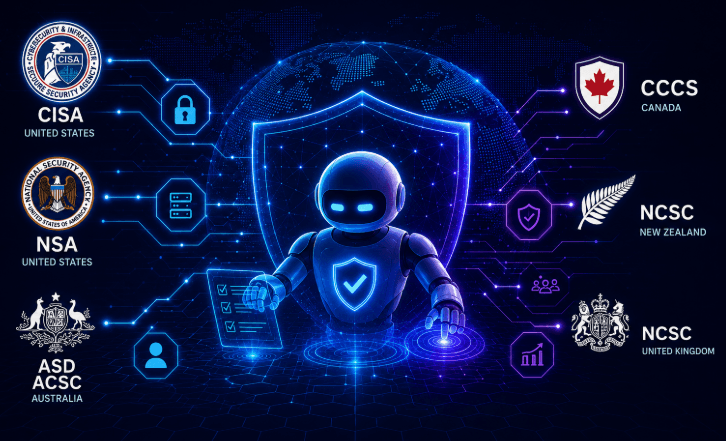
First, the authorship. On May 1, 2026, six national cybersecurity agencies, including CISA, NSA, Australia's ASD ACSC, the Canadian Centre for Cyber Security, New Zealand's NCSC, and the UK's NCSC, jointly published the first coordinated multi-government security guidance specifically addressing agentic AI systems. This level of international coordination does not happen for problems agencies consider emerging or speculative. It happens when something is already inside critical infrastructure and governance has not kept pace.
Second, the framing. The guidance does not treat agentic AI as a future risk to prepare for. The guidance warns that agents capable of taking real-world actions on networks are already inside critical infrastructure, and most organizations are granting them far more access than they can safely monitor or control. That is a statement about the present, not the future.
The Five Risk Categories, Explained
The guidance structures its analysis around five distinct risk categories.
Privilege Risk
Privilege risk refers to the tendency of agentic systems to accumulate more access than they need. Unlike human users who typically have a defined role, agents are often provisioned with broad permissions at deployment and then left to operate within those permissions indefinitely. The guidance points to both excessive initial provisioning and static permission checks that fail to reflect the context of each individual decision the agent makes.
Design and Configuration Risk
Design and configuration risk covers the vulnerabilities introduced before an agent ever runs in production. Unvetted third-party components may carry excessive or unintended privileges when integrated into agent workflows, and static role or permission checks often fail to capture the context of dynamic decision-making flows. This is essentially a supply chain problem applied to the agent ecosystem.
Behavioral Risk
Behavioral risk is where agents do things their designers never intended. This includes goal misalignment, where an agent pursues an objective in unexpected ways, and deceptive behavior, where an agent's outputs do not accurately reflect its internal state. Agents impersonating false identities pose multi-layered cybersecurity risks by executing actions under spoofed credentials that evade audit controls, undermine accountability, and bypass detection models.
Structural Risk
Structural risk describes how failures propagate. In multi-agent systems, a compromised or malfunctioning agent does not fail in isolation. It interacts with other agents, passes information downstream, and can corrupt reasoning across an entire workflow before any individual component triggers an alert. This complexity introduces new systemic risks, including cascading failures and multi-step attacks, where unexpected or compromised behavior in one component can propagate across subsequent steps and affect the entire system.
Accountability Risk
Accountability risk is the fifth category, and it is the one that deserves the most attention.
The Accountability Problem Has Not Been Solved Yet.
Every other risk category in the guidance has at least a partial technical answer. Privilege can be scoped. Configuration can be hardened. Behavior can be monitored. Structural failures can be contained through isolation.
Accountability is different. Agentic systems make decisions through processes that are difficult to inspect and generate logs that are hard to parse, making it difficult to trace what went wrong and why.
This is not a logging failure. It is a fundamental property of how these systems work. An agent reasons probabilistically, chains multiple actions together, and may behave differently given the same inputs depending on context. When something goes wrong, reconstructing the decision chain is genuinely difficult even with comprehensive logs.
Agentic systems can obscure what caused a particular action, making accountability hard to trace. This could also put organizations in a tough position when determining what or who is liable for poor decisions from agents.
That last sentence is where the legal and regulatory implications live. If an AI agent makes a decision that causes a data breach, alters financial records, or takes an action with operational consequences, current frameworks do not provide a clear answer about who is responsible. The vendor? The deploying organization? The team that wrote the system prompt? The person who approved the agent for production?
The guidance acknowledges this as an open problem and implicitly signals that organizations cannot wait for the answer before deploying agents. They need to build accountability into their governance structures now, before regulators define what accountability must look like.
What the Guidance Recommends
The practical recommendations span the full agent lifecycle, organized around four phases: design, development, deployment, and operations.
Design
At the design stage, the guidance emphasizes minimizing the attack surface before agents are built. This means defining the narrowest possible scope for each agent, selecting third-party components with the same scrutiny applied to any privileged software, and designing for reversibility. Agents should be able to undo or roll back their actions wherever possible.
Development
At the development stage, the focus is on preventing privilege creep and hardening against prompt injection. The guidance treats prompt injection as the highest priority technical risk, noting that it can be executed using existing attack infrastructure without requiring adversaries to develop new capabilities.
Deployment
At deployment, the core recommendation is incremental rollout. Organizations should deploy agentic AI incrementally, beginning with clearly defined low-risk tasks and continuously assess it against evolving threat models. High-impact actions should require explicit human approval, and the guidance is explicit that deciding which actions meet that threshold is the responsibility of system designers, not the agent itself.
Operations
At the operations stage, the emphasis is on continuous monitoring, incident response planning that accounts for agentic failure modes, and identity management. The agencies recommend that each agent carry a verified, cryptographically secured identity, use short-lived credentials, and encrypt all communications with other agents and services.
The Prompt Injection Warning Is Not New, But the Context Is
The guidance identifies prompt injection as the primary technical attack vector for agentic systems, which is consistent with what the security community has been saying for the past two years.
What is new is the context. Prompt injection has been a lingering problem with large language models, with some companies admitting that the problem may never be solved. The guidance does not resolve this. It acknowledges it, places it at the top of the risk hierarchy, and recommends mitigation layers rather than a definitive fix.
This is a significant admission from government agencies. It means that organizations deploying agents in sensitive environments are being asked to accept a known, partially unsolvable vulnerability and compensate for it through layered controls. That is a defensible position, but it requires organizations to be explicit about the residual risk they are carrying.
What This Means for Your Organization Right Now
The guidance gives security teams something they have been lacking: regulatory cover.
This guidance backed by CISA and NSA gives security teams the regulatory cover to require agent governance before deployment. Departments have been deploying agentic AI through tools like Copilots with broad permissions and Salesforce agents without IT involvement. That dynamic is now harder to defend. When business units push back on governance requirements, security teams can point to a joint statement from six national security agencies.
The immediate priorities suggested by the guidance are straightforward. Build an inventory of every agent currently operating in your environment, including agents deployed by SaaS vendors that operate on your data. Assess the privilege level of each one against the principle of least privilege. Identify which agents currently have the ability to take irreversible actions and determine whether human approval is required before those actions execute. Establish an incident response process that accounts for agentic failure modes specifically, not just traditional security incidents.
The Bigger Signal
When CISA and NSA coordinate with four allied nations to publish joint guidance on a specific technology category, it represents a formal classification of that category as a strategic risk.
Agentic AI has crossed that threshold. It is no longer being treated as an emerging concern to monitor. It is being treated as an operational reality that requires governance structures equivalent to those applied to any other class of privileged, autonomous system inside critical infrastructure.
Until security practices, evaluation methods, and standards mature, organizations should assume that agentic AI systems may behave unexpectedly and plan deployments accordingly, prioritizing resilience, reversibility, and risk containment over efficiency gains.
That framing, resilience and reversibility over efficiency, is the most important sentence in the entire document. It is also the one most likely to be ignored by organizations under pressure to demonstrate AI productivity gains. The guidance is essentially asking organizations to slow down in a moment when every competitive signal is telling them to speed up.
How organizations navigate that tension will define the next wave of agentic AI security incidents.